
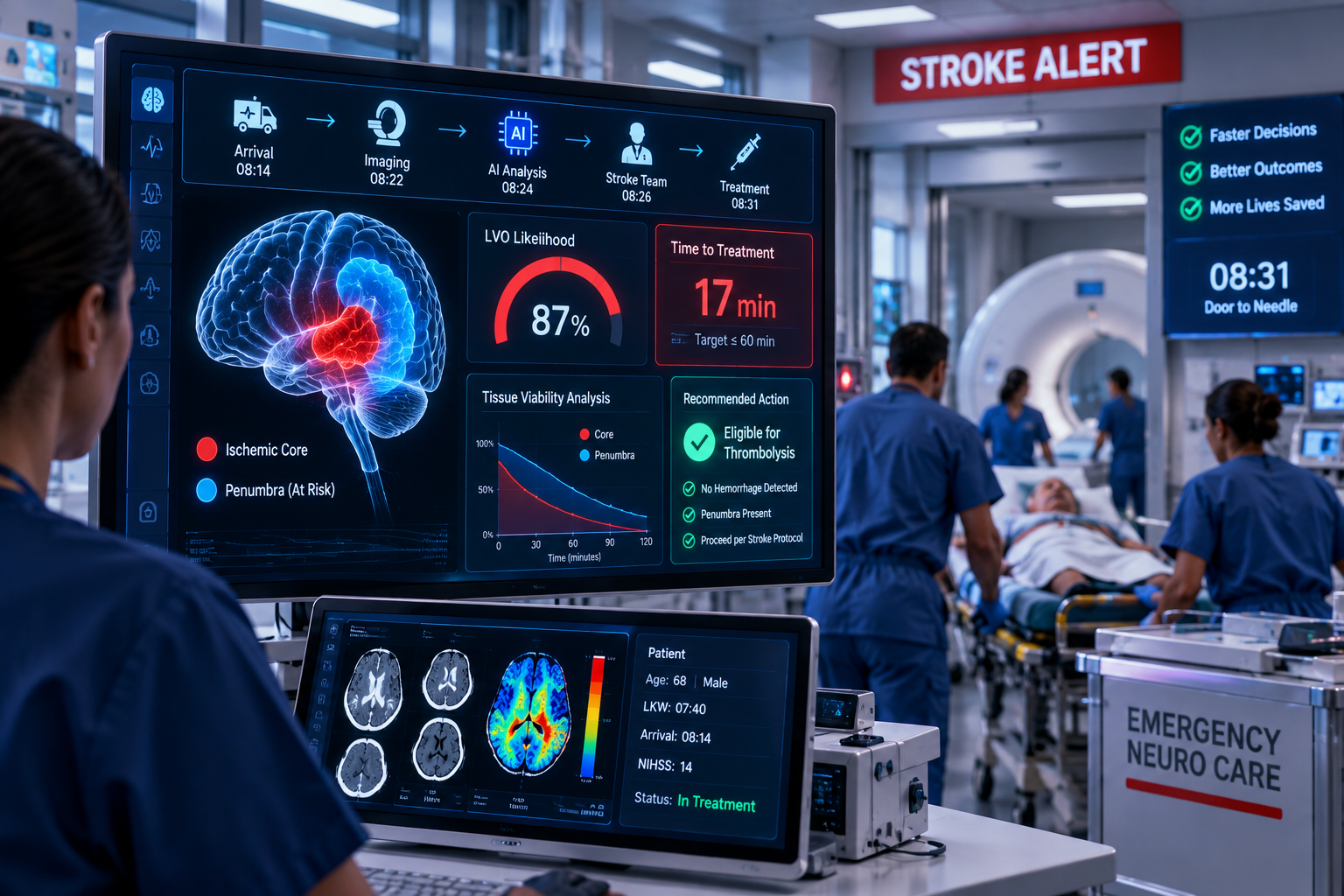
In emergency stroke management, “time is brain.” When an acute ischemic stroke occurs, millions of neurons die each minute perfusion remains blocked. Minimizing the door-to-needle (DTN) time for intravenous thrombolysis and endovascular thrombectomy (EVT) is the single most critical factor in preventing permanent neurological disability.
Historically, determining patient candidacy for reperfusion therapy relies on manual review of unenhanced CT scans, CT angiography (CTA), and CT perfusion images by on-call radiologists and neurointerventionalists. In busy emergency departments, waiting for imaging transfers, manual software rendering, and specialist consultation introduces 30 to 60 minutes of critical delay—frequently missing the narrow therapeutic window for salvaging ischemic tissue.
To accelerate life-saving interventions, health networks are implementing Real-Time Stroke Triage & Penumbra Analytics Engines directly within Emergency Radiology Workflows. By processing raw CT perfusion scans automatically at the scanner console, these engines calculate core-to-penumbra ratios and alert neurovascular stroke teams within minutes of image acquisition.
Accelerating Neurovascular Care: Manual Review vs. Real-Time Perfusion Analytics
Automated penumbra analytics eliminate imaging bottlenecks to enable rapid reperfusion decisions.
[Patient Completes Emergency Brain CT / CTA / CTP Scan]
│
▼
[GoLiveX Real-Time Stroke Perfusion Analytics]
│
(Calculates Ischemic Core vs. Salvageable Penumbra)
│
▼
[Instant EHR / Mobile Alert to Neurointerventional Team]
Operational Comparison: Traditional Emergency Triage vs. Real-Time Perfusion Analytics
| Clinical Vector | Legacy Manual Stroke Workflow | GoLiveX Real-Time Stroke Analytics Engine |
| Image Processing | Manual rendering and threshold calculation by radiology staff. | Automated instantaneous processing directly at the imaging console. |
| Penumbra Quantification | Subjective visual estimation based on multi-slice CT scans. | Automated precise volumetric calculation of core infarct vs. penumbra tissue. |
| Notification Velocity | Sequential phone calls following radiology report signature. | Simultaneous real-time alerts pushed to stroke team mobile devices. |
| Treatment Decision | 45 to 90 minutes door-to-needle / door-to-puncture time. | Under 20 minutes door-to-decision time, accelerating reperfusion therapy. |
Primary Strategic Benefits for Emergency Neurovascular Services
- Rapid Penumbra Identification: Advanced volumetric algorithms measure cerebral blood volume (CBV) and cerebral blood flow (CBF) deficits, immediately flagging salvageable brain tissue.
- Automated Large Vessel Occlusion (LVO) Detection: High-resolution CTA analysis identifies arterial blockages in the middle cerebral or internal carotid arteries, instantly initiating EVT protocol workflows.
- Multi-Disciplinary Mobile Alerts: Radiologists, neurologists, and catheterization lab teams receive synchronized, interactive imaging overlays simultaneously on mobile devices, enabling fast collaborative decision-making.
Key Takeaways
- Minimizing Treatment Delays: Automating neuroimaging analysis shortens the time to thrombolysis and endovascular intervention.
- Precise Penumbra Mapping: Quantitative tissue volume calculations identify patients who will benefit from reperfusion therapy.
- Instant Team Activation: Automated LVO detection alerts interventional stroke teams simultaneously, cutting door-to-puncture times.
- Improved Neurological Recovery: Accelerating clinical decision-making preserves brain function and reduces long-term disability for acute stroke patients.
Leave a Reply