
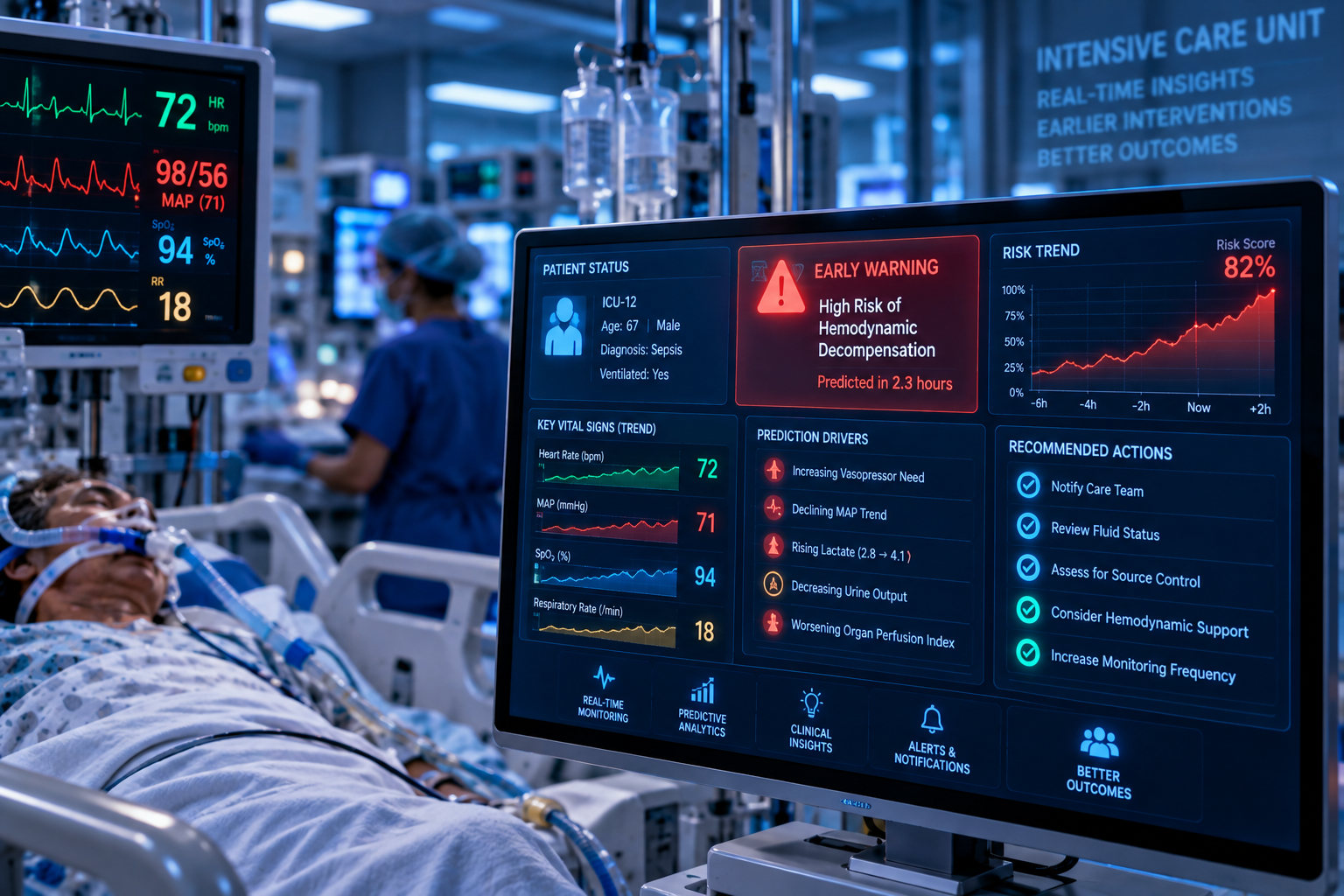
In critical care and intensive care units (ICUs), hemodynamic instability—driven by septic shock, acute myocardial injury, or hypovolemia—remains a leading cause of patient mortality. When a critically ill patient experiences rapid circulatory collapse, every minute spent before initiating vasopressor support or fluid resuscitation increases the risk of multi-organ failure.
Historically, ICU teams monitor patients using standard threshold alarms set on bedside vital sign monitors. However, these traditional monitors operate on reactive, single-parameter logic (e.g., sounding an alarm only after mean arterial pressure drops below 65 mmHg). In complex physiological states, compensatory mechanisms (such as peripheral vasoconstriction and elevated heart rate) mask underlying tissue hypoperfusion long before systemic blood pressure drops.
To prevent sudden cardiovascular collapse, health networks are deploying Real-Time Hemodynamic Decompensation Prediction Engines integrated with Central ICU Telemetry. By processing high-frequency continuous waveforms—including arterial line pressure, central venous pressure, pulse oximetry, and electrocardiography—these engines detect subtle, non-linear physiological decay hours before clinical decompensation occurs.
Accelerating Critical Care Response: Threshold Alarms vs. Real-Time Predictive Telemetry
Predictive analytics evaluate multi-parameter trend velocity to alert clinical teams prior to circulatory failure.
[Continuous High-Frequency Waveform Telemetry Streaming]
│
▼
[GoLiveX Real-Time Hemodynamic Prediction Engine]
│
(Analyzes Pulse Contour, Variability & Compensatory Drift)
│
▼
[Early Decompensation Risk Alert Delivered to ICU Workstation]
Operational Comparison: Traditional ICU Alarms vs. Real-Time Predictive Analytics
| Clinical Vector | Legacy Bedside Threshold Alarms | GoLiveX Real-Time Hemodynamic Engine |
| Monitoring Logic | Single-parameter; triggers only when a value crosses a static threshold. | Multi-parameter; cross-evaluates complex interactions across vital waveforms. |
| Detection Window | Reactive; alerts after hypoperfusion and hypotension have already occurred. | Predictive; identifies cardiovascular instability 1 to 4 hours before collapse. |
| Alarm Fatigue | High; frequent false alarms caused by motion artifacts or momentary spikes. | Low; advanced signal processing filters out noise to ensure high alert specificity. |
| Intervention Strategy | Emergency resuscitation following acute drop in blood pressure. | Proactive stabilization, optimization of fluid management, and timely vasopressor initiation. |
Primary Strategic Benefits for Critical Care Units
- Early Septic Shock Identification: By analyzing arterial line pulse contour variability alongside heart rate turbulence, algorithms spot subclinical circulatory distress early.
- Reduction in Alarm Fatigue: Filtering out transient artifacts cuts unnecessary noise, ensuring ICU staff respond quickly to genuine early-warning alerts.
- Closed-Loop Fluid Responsiveness Support: Provides bedside clinicians with precise indices (such as Stroke Volume Variation) to determine whether a patient will benefit from fluid administration or vasopressors.
Key Takeaways
- Beyond Reactive Thresholds: Standard alarms fail to catch compensatory physiological mechanisms, delaying life-saving critical care interventions.
- Continuous Waveform Analytics: High-frequency processing of invasive arterial lines and telemetry surfaces hidden trends hours before hypotension presents.
- Mitigating Alarm Fatigue: Multi-parameter validation reduces false positives, helping ICU nurses focus on actionable clinical alerts.
- Proactive Hemodynamic Stabilization: Early detection enables timely fluid and vasopressor management, preventing organ failure and improving ICU survival rates.
Leave a Reply