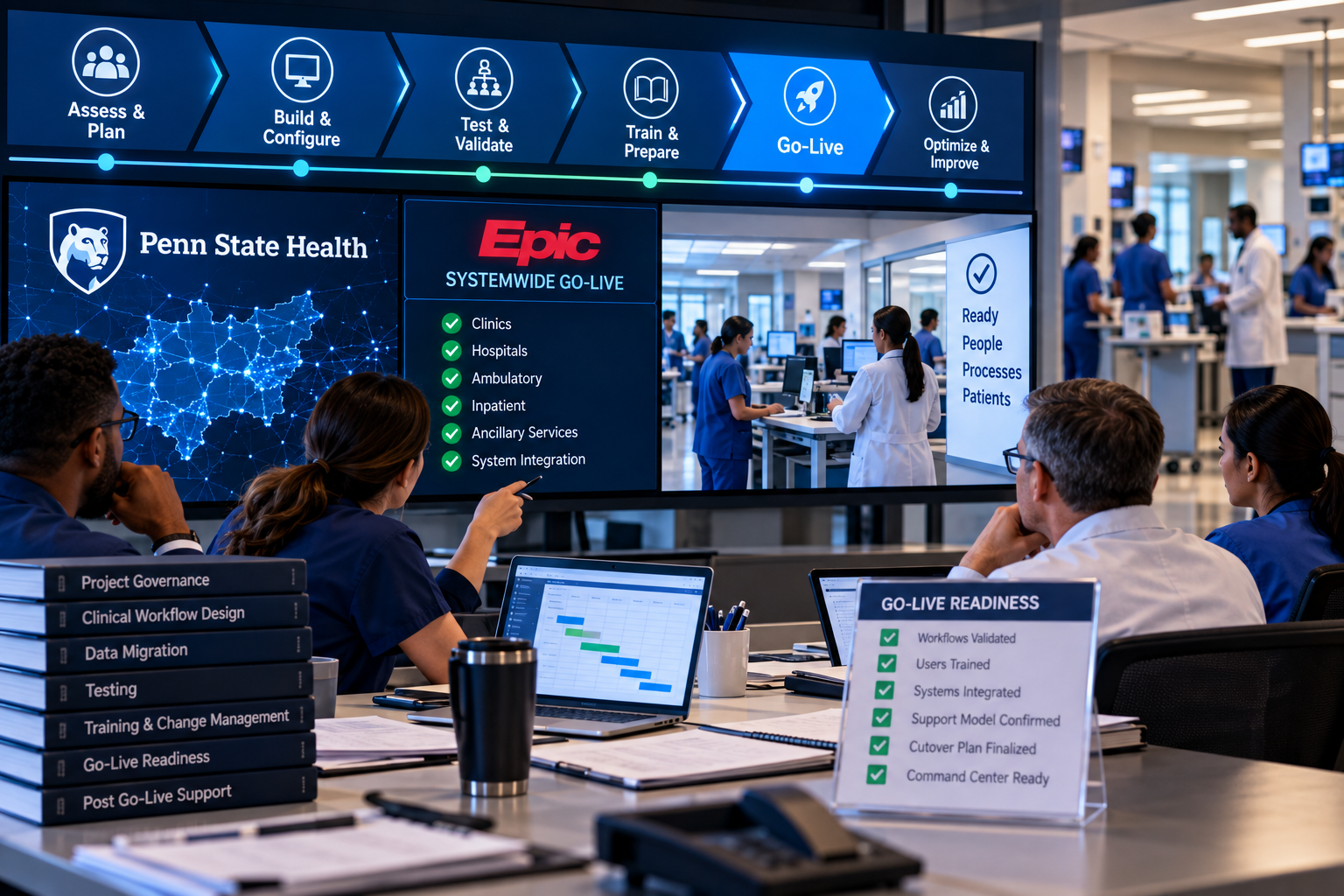
On October 31, Penn State Health plans to make one of the most consequential technology changes a health system can undertake.
Epic will go live across the organization.
For patients, the most visible change may be simpler access to care. For clinicians, nurses, schedulers, revenue cycle teams, IT staff and operational leaders, however, the transition represents something much larger: thousands of workflows, habits, screens, decisions and daily processes changing at the same time.
And that is where an EHR implementation either becomes transformational or painfully disruptive.
Penn State Health says the systemwide launch will create a unified electronic health record and billing environment and introduce Epic MyChart as its patient portal. MyChart will replace five separate patient portals, giving patients a single place to communicate with care teams, access test results, schedule appointments, manage prescriptions, join virtual visits and review their health information.
The technology story is significant.
But the human story may matter even more.
A Go-Live Is Not the Finish Line
Health systems often spend years preparing for a major EHR implementation.
Infrastructure is built. Interfaces are tested. Data is migrated. Workflows are mapped. Security roles are configured. Training environments are established. Thousands of employees complete required education.
Then comes go-live.
That moment can create the impression that the implementation is complete.
It isn’t.
In many ways, the most important phase has just begun.
The real test starts when a physician needs to enter an unfamiliar order while patients are waiting.
When an emergency department nurse cannot immediately locate the documentation workflow previously completed almost automatically.
When a scheduler encounters a scenario that wasn’t covered during training.
When a pharmacist sees information displayed differently.
When a clinician understands the clinical task perfectly but does not yet know how the new system expects that task to be completed.
These are not necessarily software failures.
They are the normal consequences of changing the digital operating system of a healthcare organization.
That distinction matters.
Penn State Health says the unified Epic environment is intended to streamline workflows, reduce manual tasks, improve communication and give clinicians and support staff greater visibility across hospitals and outpatient practices. The organization also expects the platform to support research, education, data use and emerging AI capabilities.
But those benefits depend on people being able to use the platform effectively.
2026 Is Becoming a Major Year for EHR Change
Penn State Health is not making this transition in isolation.
Hospitals across the country are implementing, replacing or consolidating electronic health record systems in 2026.
Becker’s reported this month that EHR migrations have become some of healthcare’s largest capital technology projects, ranging from smaller hospital implementations to projects valued in the hundreds of millions or even more than $1 billion. Health systems including Adventist Health, Northwell Health, Sarasota Memorial Health Care System and multiple Department of Veterans Affairs facilities have been part of major EHR transitions this year.
Epic continues to expand its presence as well. According to KLAS data cited by Becker’s, Epic accounted for 43.7% of the U.S. acute care hospital EHR market by hospital share at the end of 2025, compared with 42.3% a year earlier.
The scale of these migrations creates an important reality for healthcare organizations:
EHR readiness is becoming an operational competency, not a one-time IT project.
Health systems need more than technically successful implementations.
They need clinicians who can work safely and confidently inside those systems from the moment they go live.
Training Alone Cannot Prepare Users for Every Workflow
Formal EHR training is essential.
It establishes the fundamentals users need before entering a production environment.
But there is a limitation that nearly every large implementation eventually encounters: classroom learning and real clinical work are not the same thing.
A physician may understand how to place an order during training but encounter a different combination of clinical circumstances during an actual shift.
A nurse may know where documentation belongs but struggle to remember the exact navigation path while managing multiple patients.
A new employee may join months after the implementation team has left.
A workflow may change after optimization.
An Epic upgrade may introduce new functionality.
A department may use the same EHR differently because of specialty-specific workflows.
That gap between knowing the clinical task and knowing how to execute it efficiently inside the EHR is where support becomes critical.
Traditional training prepares users.
Go-live support helps users perform.
Optimization helps them improve.
Healthcare organizations need all three.
Why At-the-Elbow Support Still Matters
One of the most effective resources during a major EHR transition remains remarkably simple: placing knowledgeable support where clinicians are actually working.
At-the-elbow support allows users to receive immediate assistance without abandoning the clinical workflow to search through lengthy documentation, submit a help desk ticket or wait for someone to return a call.
The value becomes especially obvious during the first days of a go-live.
A 30-second answer can prevent several minutes of confusion.
A workflow clarification can keep a patient moving.
A quick explanation can prevent the same mistake from being repeated throughout a shift.
And one experienced support specialist can identify patterns affecting an entire department.
Intermountain Health demonstrated the scale at which this support can be deployed during its major Epic launch in September 2025. The health system told Becker’s it used around-the-clock command centers, at-the-elbow assistance, super-user coverage and an Epic coaching hotline during the initial transition period. The organization also emphasized workflow testing and caregiver training before go-live.
That combination is important.
Technology readiness and human readiness cannot be separated.
The Support Model Is Also Changing
There is another challenge.
Hospitals cannot maintain massive physical go-live teams forever.
Traditional at-the-elbow support is extremely valuable during implementation, but eventually outside consultants leave, temporary command centers close and organizations transition into normal operations.
The questions do not disappear.
New employees arrive.
Experienced users forget infrequently used workflows.
Departments change processes.
EHR vendors release upgrades.
Hospitals enable new modules.
AI functionality enters existing workflows.
Optimization creates new ways of completing familiar tasks.
Healthcare organizations therefore need to think beyond the traditional model of intensive support for several weeks followed by a dramatic reduction in assistance.
The next generation of EHR support will increasingly combine human expertise with intelligent, always-available workflow guidance.
A clinician encountering an unfamiliar workflow should not necessarily have to search through a 60-page training guide or wait for a help desk response.
They should be able to ask a clear question and receive concise, workflow-specific guidance when they need it.
That does not eliminate trainers, analysts, super users or support teams.
It makes their expertise easier to access and allows human teams to concentrate on more complicated issues.
AI Is Making This Even More Important
The EHR itself is changing.
Epic is increasingly adding artificial intelligence across clinical workflows, while Oracle Health and other vendors are doing the same.
Becker’s recently described the EHR as an emerging “front door” for healthcare AI as vendors and health systems integrate AI functionality more deeply into existing clinical environments.
Epic is already introducing AI tools for areas including clinical documentation and information synthesis. Hospitals have begun deploying and testing these capabilities in real workflows.
Penn State Health has also identified data and AI capabilities as part of the strategic value expected from its new Epic platform.
This creates another layer of readiness.
Health systems will not only need to teach clinicians how to use an EHR.
They will increasingly need to help clinicians understand how AI interacts with the EHR, where automated recommendations appear, what new workflows are available, what still requires human review and how those tools should fit into clinical practice.
The learning curve is not getting smaller.
It is becoming continuous.
Five Questions Health Systems Should Ask Before Go-Live
Before a major EHR launch, healthcare leaders should be able to answer several practical questions:
Can clinicians get help in seconds, not minutes?
When clinical operations are moving quickly, support must be available at the speed of the workflow.
Are support resources available where the work happens?
Emergency departments, inpatient units, ambulatory clinics, operating rooms, laboratories and specialty departments have different workflows and different pressures.
What happens after the go-live consultants leave?
The support strategy should extend beyond launch week.
Can the organization identify recurring workflow problems?
Repeated questions are valuable data. They can reveal training deficiencies, confusing configuration, usability problems or workflows that need optimization.
How will new employees learn the system six months later?
A mature EHR adoption strategy must support onboarding and ongoing learning, not only the original implementation.
These questions are increasingly important as healthcare organizations invest hundreds of millions of dollars in digital transformation.
Penn State Health’s Real Opportunity Begins October 31
Penn State Health’s Epic implementation has the potential to accomplish something substantial.
A single EHR can create a more connected clinical environment.
A unified patient portal can simplify digital access.
Standardized workflows can reduce fragmentation.
Shared information can strengthen care coordination.
Integrated data can support research, analytics and AI.
But none of those outcomes occur simply because an EHR has been installed.
Technology creates capability.
People create results.
That is why the most successful EHR implementations should ultimately be measured not simply by whether the system went live on schedule, but by what happens afterward.
Can clinicians find what they need?
Can nurses document efficiently?
Can providers place orders confidently?
Can support teams resolve problems quickly?
Can new users become proficient faster?
Can the organization continuously improve the workflows it spent years building?
On October 31, Penn State Health will turn on Epic across the health system.
The software launch will happen in a day.
The work of adoption, optimization and continuous learning will continue long after it.
And that may ultimately determine the real return on the investment.
About GoLiveX
GoLiveX is an AI-powered EHR workflow guidance platform designed to help healthcare professionals navigate Epic, Oracle Health/Cerner, MEDITECH and other clinical systems. It provides on-demand workflow guidance without requiring protected health information, helping clinicians and healthcare support teams find answers when they need them during go-live, stabilization, optimization and ongoing EHR use.
SEO Publishing Block
Recommended SEO Title:
Penn State Health Epic Go-Live Highlights the Need for EHR Readiness and Clinical Workflow Support
URL Slug:
penn-state-health-epic-go-live-ehr-readiness-support
Primary / Focus Keyword:
Epic go-live support
Secondary Keywords:
Epic implementation, EHR go-live, EHR implementation support, Epic training, at-the-elbow support, EHR workflow support, clinical workflow training, Epic go-live readiness, healthcare IT implementation, clinician EHR training, Penn State Health Epic, EHR optimization, AI EHR support
Meta Description:
Penn State Health will launch Epic systemwide on October 31. Here is why clinician readiness, at-the-elbow support and continuous EHR workflow guidance are critical to successful go-live adoption.
Recommended Category:
EHR Implementation & Go-Live
Suggested Tags:
Epic, Penn State Health, EHR Go-Live, Healthcare IT, EHR Training, At-the-Elbow Support, Clinical Workflows, EHR Optimization, Digital Health
Suggested Social Headline:
Penn State Health Is Going Live With Epic. The Hard Part Starts After the Switch Is Flipped.
Source Story:
Becker’s Hospital Review, “Penn State Health to launch Epic systemwide,” supplemented by Penn State Health’s official Epic implementation announcement.
Leave a Reply