
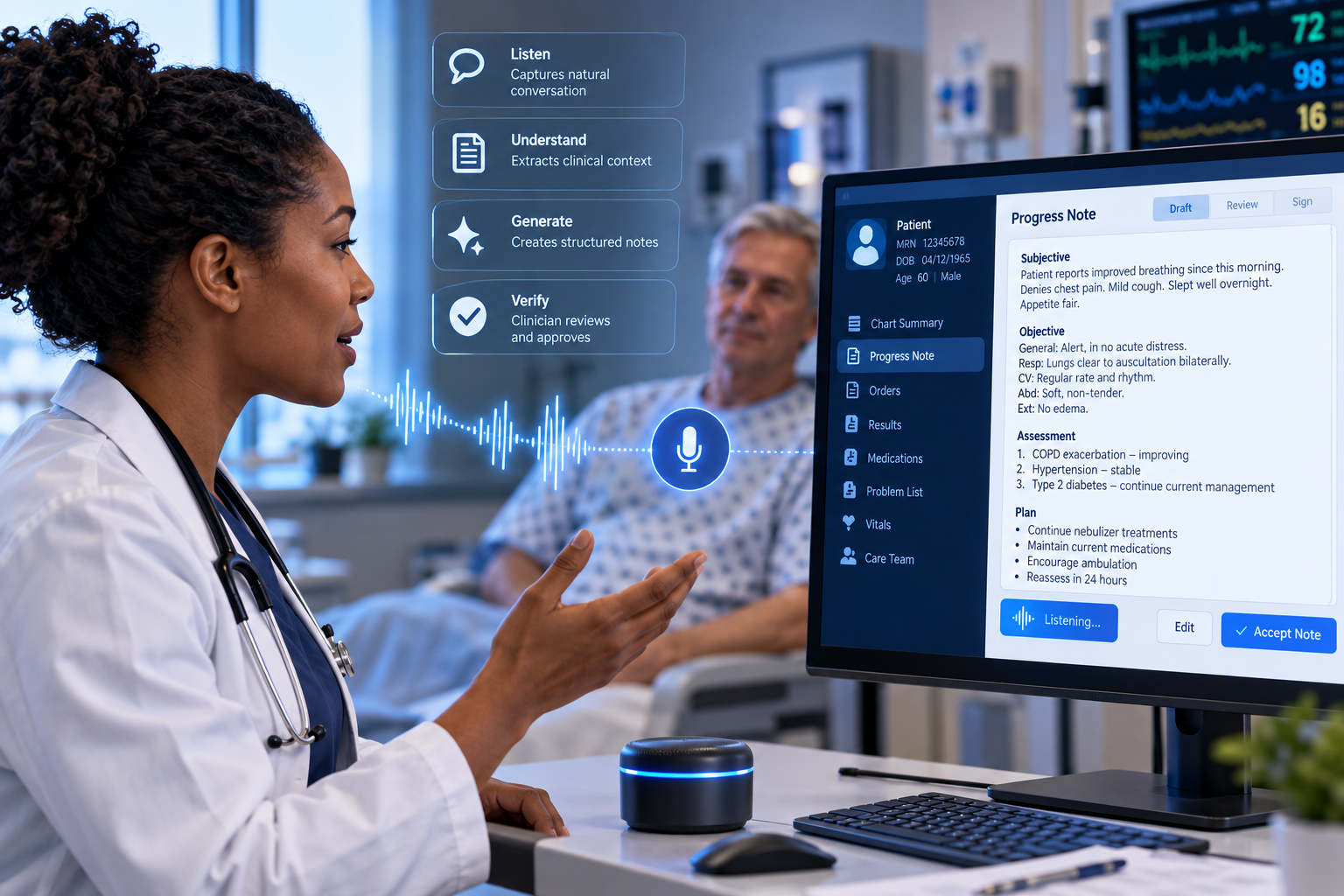
For decades, the promise of Electronic Health Records (EHRs) has been overshadowed by the immense administrative burden placed on providers. Clinicians routinely spend hours beyond their scheduled shifts completing medical charts, leading to widespread burnout. Traditional dictation software helped, but it still required physicians to manually organize their thoughts and navigate complex EHR interfaces.
By 2026, healthcare systems are moving beyond basic dictation toward Ambient Clinical Voice Technology combined with Intelligent Clinical Documentation. These ambient listening systems operate passively in the background of a patient encounter, securely capturing the natural, multi-speaker conversation between the physician and the patient.
Using advanced AI, these platforms instantly synthesize the dialogue into structured, billing-compliant clinical notes, allowing providers to return their focus entirely to the patient rather than a computer screen.
Documentation Evolution: Manual Charting vs. Ambient Voice Technology
Ambient systems shift the EHR from a data-entry repository into an active, context-aware clinical assistant.
| Workflow Vector | Traditional EHR Documentation | Ambient Clinical Voice Documentation |
| Data Capture | Active; requires manual typing, clicking, or structured dictation commands. | Passive; natural language processing listens to the organic patient-provider conversation. |
| Note Structuring | Manual; providers must organize details into subjective, objective, assessment, and plan formats. | Automated; AI extracts key clinical details and generates structured templates without changing clinical intent. |
| Workflow Interruption | High; clinicians look at screens, reducing direct eye contact and patient engagement. | Zero; allows for completely hands-free interactions, improving patient trust and engagement. |
| Time Savings | Minimal; documentation frequently spills over into “pajama time” after hours. | Massive; early studies show up to a 70% reduction in after-hours documentation time. |
The Ambient Documentation Pipeline
Ambient listening transforms raw exam room dialogue into actionable, interoperable health data.
[Patient & Provider Consultation]
│
(Natural Conversation & Examination)
│
▼
[Ambient Voice Processing Engine]
│
(Speaker Diarization & Semantic Intent Extraction)
│
▼
[Intelligent Clinical Documentation Builder]
│
▼
[Drafted SOAP Note & Coded Billing Recommendations]
│
▼
[Provider Review, One-Click Sign-Off & EHR Sync]
Core Features of Ambient EHR Integration
- Context-Aware Extraction: The AI automatically filters out casual small talk, pulling only the relevant medical history, reported symptoms, and prescribed treatment plans into the clinical record.
- Workflow-Aligned Design: Drafted notes are embedded directly into the provider’s existing clinical workflow, reducing screen clicks and eliminating the need to duplicate patient history.
- Immediate Data Availability: By finalizing documentation at the point of care, structured data is immediately available for FHIR-based interoperability, supporting real-time decision-making across the care continuum.
Key Takeaways
- Eliminating “Pajama Time”: Automating charting workflows reclaims hours of personal time for providers, directly combatting clinician burnout.
- Enhanced Patient Interaction: Hands-free documentation restores direct eye contact and conversational flow between doctors and patients.
- Higher Accuracy: AI-assisted systems capture subtle clinical details that might be forgotten if a note is transcribed hours after the actual appointment.
- Streamlined Billing: Integrating clinical details natively with correct billing codes accelerates the hospital revenue cycle.
Leave a Reply