
Most EHR implementations are described as software projects.
Westchester Medical Center Health Network is showing why that description no longer goes far enough.
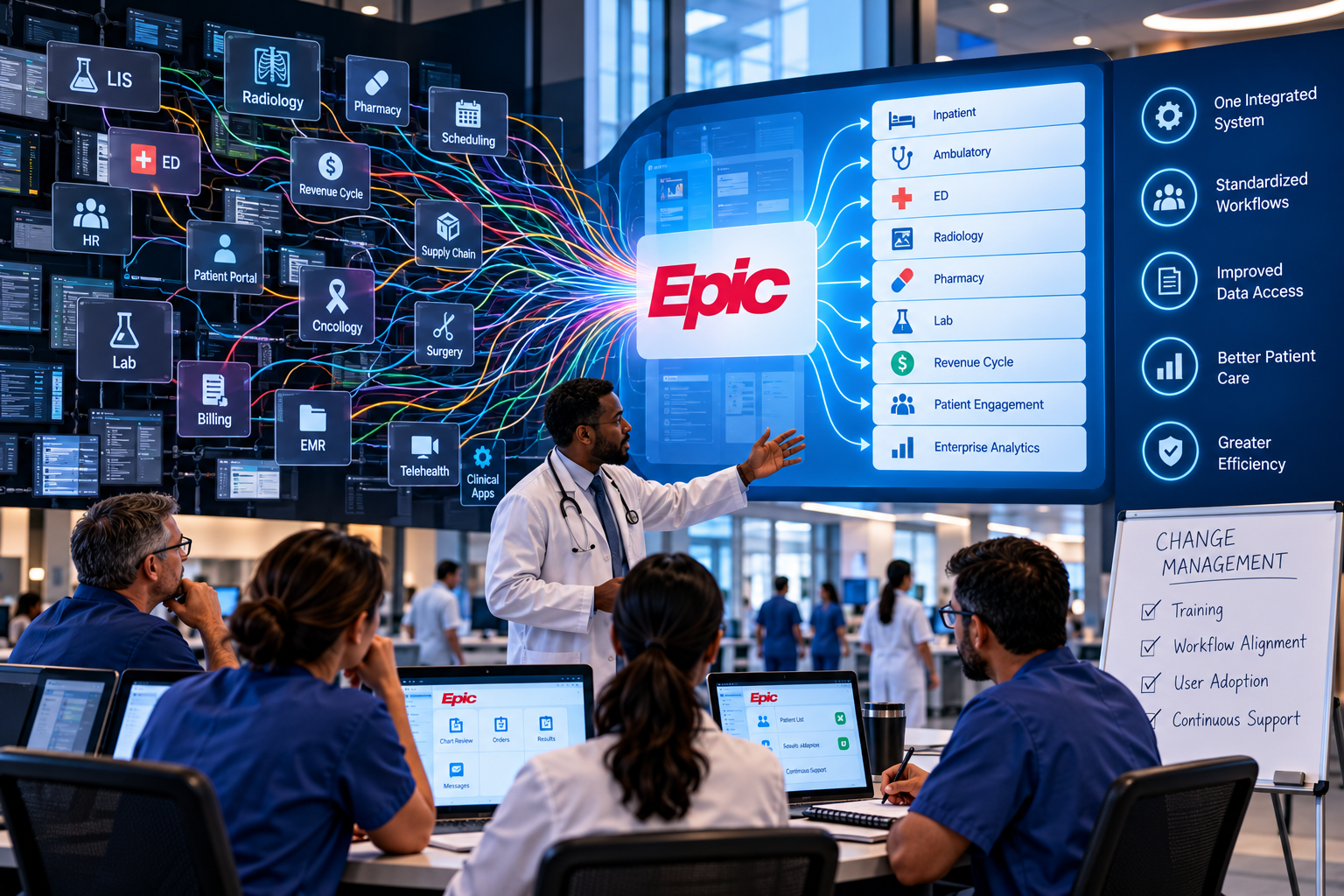
WMCHealth is implementing Epic across its network, but the project is expected to do much more than replace an electronic health record. By the time the transformation is complete, the health system expects Epic to displace 88 separate applications that accumulated across the organization over years of growth.
That means WMCHealth is not simply asking clinicians and employees to learn Epic.
It is asking thousands of people to unlearn dozens of systems, screens, shortcuts, workflows and habits that have become part of how they work.
And that may be the harder transformation.
Becker’s Hospital Review reports that WMCHealth currently operates a fragmented technology environment across its nine-hospital network. Some facilities use Oracle Health, formerly Cerner. Others use Altera’s Paragon platform, formerly Allscripts, while another smaller system supports a skilled nursing facility. WMCHealth plans to replace much of that fragmented environment with a single enterprise Epic implementation.
The go-live is scheduled for December 4, 2027.
The technology transition will happen on a defined date.
The behavioral transition will take much longer.
88 Applications Means 88 Sources of Institutional Muscle Memory
There is an understandable financial argument for application consolidation.
Every additional application can bring licensing costs, infrastructure requirements, interfaces, security responsibilities, maintenance, vendor relationships and support requirements.
Multiply those costs across dozens of applications and consolidation begins to make enormous financial sense.
WMCHealth CIO Leo Bodden told Becker’s that once the Epic implementation is complete and the legacy applications are retired, the health system expects its costs to be significantly lower than what it currently spends supporting its existing environment.
But there is another form of technical debt that does not appear neatly on an IT balance sheet.
Human workflow debt.
Every application being retired has users who know how to operate it.
Some of those users may have spent years developing expertise.
They know where information lives.
They know the sequence of clicks.
They know the strange workaround required for an unusual situation.
They know which screen opens next.
They know what happens when something goes wrong.
That knowledge becomes automatic.
When the application disappears, much of that muscle memory becomes useless overnight.
A successful consolidation strategy therefore has to retire two things simultaneously:
The old software.
And the old way of working.
WMCHealth Is Preparing for a True Big-Bang Transformation
WMCHealth’s own Epic implementation planning documents show the scale of what is coming.
The health system has said Epic will operate as a single enterprise instance and that the implementation is planned as a big-bang go-live, with all facilities included in scope. Specialty areas under consideration include major clinical environments such as laboratory, pharmacy, operating room, anesthesia, oncology, radiology, cardiology and behavioral health functionality.
A big-bang implementation creates one enormous advantage.
Everyone moves together.
It can eliminate years of maintaining parallel environments while different facilities wait for their turn.
But it also concentrates risk.
Instead of one department learning a new workflow, many departments are learning simultaneously.
Instead of one facility needing support, the entire enterprise may need support.
Emergency departments.
Inpatient nursing.
Ambulatory clinics.
Operating rooms.
Pharmacies.
Laboratories.
Radiology.
Cardiology.
Registration.
Scheduling.
Revenue cycle.
Health information management.
Every one of those environments contains dozens, sometimes hundreds, of workflows.
And every workflow eventually reaches the same question:
Does the user know what to do next?
Application Consolidation Creates a Training Problem That IT Architecture Diagrams Do Not Show
Imagine a physician who has practiced at one WMCHealth hospital for several years.
That physician knows the existing EHR well.
Then Epic arrives.
The clinical knowledge has not changed.
The patient still requires the same care.
But the digital pathway for performing that care may be completely different.
Where is the order?
Where is the result?
How do I modify it?
Where are messages?
How do I complete the note?
How do I review medication history?
Where do I find outside records?
How is discharge handled?
Now multiply that experience across thousands of employees.
Then multiply it again across dozens of applications being eliminated.
This is why EHR consolidation cannot be treated simply as a technology simplification initiative.
From the user’s perspective, consolidation may initially feel like increased complexity.
IT sees fewer applications.
The clinician sees an unfamiliar system.
The CIO sees application rationalization.
The nurse sees a workflow that used to take three familiar steps and now requires learning a new sequence.
Both views can be correct.
The organization only realizes the benefits when the second problem is solved.
One EHR Can Create Consistency, but Only if People Use It Consistently
The strategic value of an enterprise EHR is significant.
A unified environment can reduce fragmentation.
Patient information can move more easily across facilities.
Clinicians can operate from a shared record.
Organizations can standardize workflows.
Training can become more consistent.
Analytics can become easier.
Security can become easier to manage.
Application support can become less fragmented.
WMCHealth has already been pursuing greater organizational integration beyond technology. In July 2026, the system announced that eight of its hospitals had been unified under a single hospital license, a change intended to improve coordination and allow the network to operate more cohesively.
Epic fits naturally into that broader strategy.
But putting everyone on one platform does not automatically mean everyone uses the platform in the same way.
Local habits can survive technology consolidation.
A department may create a workaround.
A clinician may continue using an inefficient sequence because it feels familiar.
One location may develop unofficial instructions.
Another may interpret the workflow differently.
Screenshots get circulated.
Tip sheets become outdated.
Experienced employees teach new employees the way they learned, even after the workflow changes.
Before long, one standardized EHR can contain multiple unofficial ways of working.
That is why workflow governance matters just as much as application governance.
Go-Live Support Becomes More Important When Systems Are Consolidated
During a major EHR implementation, mistakes are sometimes framed as training problems.
That is too simplistic.
No realistic training program can prepare every user for every situation they will encounter in a live clinical environment.
Users can be prepared for common workflows.
They can practice.
They can complete simulations.
They can receive role-based training.
But real healthcare does not happen according to a training script.
A patient does something unexpected.
A clinician encounters a workflow they only perform twice a year.
A nurse floats into another department.
A physician covering another service encounters a specialty workflow.
A new employee arrives after the original training sessions have ended.
This is why large implementations depend heavily on support after training.
At-the-elbow personnel.
Super users.
Command centers.
Analysts.
Trainers.
Application teams.
Service desks.
All of these resources help close the gap between classroom readiness and real-world proficiency.
For WMCHealth, that gap could become particularly important because the organization is moving from multiple legacy environments into a single enterprise platform.
The question is not simply whether employees understand Epic.
It is whether they can translate everything they previously did across dozens of applications into the correct new workflow.
The Most Valuable Go-Live Questions Are Often the Simplest
During go-live, support teams hear questions that may appear basic:
“Where is this?”
“How do I document this?”
“How do I change this order?”
“Where did this information move?”
“How do I complete this workflow now?”
Those questions are not evidence that clinicians lack expertise.
A cardiovascular surgeon does not become less capable because the location of an Epic activity is unfamiliar.
An experienced nurse does not lose clinical judgment because a documentation workflow has changed.
A pharmacist does not forget pharmacy practice because medication functionality appears differently.
They are adapting clinical expertise to a new digital environment.
The faster that adaptation occurs, the sooner the organization begins realizing the value of the EHR investment.
That is why workflow guidance matters.
Every Retired Application Creates an Opportunity to Simplify
There is another side to WMCHealth’s transition.
Replacing 88 applications is not merely disruptive.
It is an opportunity.
Health systems accumulate software for understandable reasons.
A new department needs functionality.
An acquired hospital brings an existing platform.
A specialty purchases a point solution.
A temporary solution becomes permanent.
Years pass.
Eventually users are logging into multiple systems simply to complete one episode of work.
Information gets copied between applications.
Passwords multiply.
Interfaces have to be maintained.
Employees must remember which application contains which information.
That environment creates cognitive burden.
A successful Epic consolidation could remove a significant amount of that fragmentation.
But there is an important condition.
The new workflow must actually be simpler.
Replacing five applications with one system has little value if employees require extensive manual workarounds inside the replacement.
Application rationalization should therefore be paired with workflow rationalization.
Organizations should not merely ask:
“What software can Epic replace?”
They should also ask:
“What unnecessary steps can disappear when that software is replaced?”
That is where technology transformation begins producing operational transformation.
WMCHealth Is Also Changing More Than the EHR
The complexity becomes even more striking because Epic is not WMCHealth’s only major transformation initiative.
Becker’s reports that WMCHealth is also undertaking a systemwide Workday enterprise resource planning rollout affecting finance, human resources and supply chain operations.
WMCHealth’s own workforce-management planning documents acknowledge the challenge of simultaneous transformation. The organization describes coordinated change management across Workday, workforce management and EHR initiatives, including stakeholder engagement, communications, role-based training and adoption planning. The documents specifically reference managing change saturation across the organization.
That phrase deserves attention.
Change saturation.
Healthcare workers already operate in high-pressure environments.
When multiple enterprise platforms change within a relatively short period, employees are not simply learning one new tool.
They are learning a new digital workplace.
That makes accessible, continuous guidance far more important.
What Happens Six Months After Go-Live?
Implementation plans naturally concentrate attention on the launch.
But a different question may matter more:
What happens in June 2028?
By then, the consultants may be gone.
Temporary command-center staffing may be reduced.
At-the-elbow resources may have moved to another project.
But employees will still have questions.
New employees will need onboarding.
Existing employees will encounter unfamiliar workflows.
Epic upgrades will introduce changes.
Departments will optimize processes.
New functionality may be activated.
Artificial intelligence tools may alter documentation and information retrieval.
The EHR will continue evolving.
Healthcare organizations therefore need to think beyond go-live support and toward continuous EHR enablement.
Support cannot disappear simply because the implementation project has been declared complete.
This Is the Problem GoLiveX Is Built Around
GoLiveX approaches EHR support from a simple premise:
Healthcare professionals should be able to get workflow guidance when they need it, not only when a trainer happens to be standing nearby.
GoLiveX provides AI-powered guidance for major EHR platforms including Epic, Oracle Health/Cerner and MEDITECH.
That becomes particularly relevant in consolidation projects.
Before an Epic transition, one organization may contain employees familiar with Cerner.
Others may come from Allscripts or Paragon environments.
Others may know MEDITECH.
New employees may have Epic experience from a previous hospital but still need to understand how the current organization has configured its workflows.
The platform name alone does not answer the question.
Users need practical guidance about what they are trying to accomplish.
GoLiveX is designed to support that workflow-learning layer without requiring protected health information.
It is not intended to replace formal training, super users, analysts or at-the-elbow teams.
It can extend their reach.
During go-live, it can provide another path to an answer.
After go-live, it can help preserve access to workflow knowledge when temporary implementation resources are no longer available.
And during optimization, it can help users adapt as workflows continue changing.
The Real ROI of Application Consolidation Depends on the User
WMCHealth expects meaningful financial benefits from retiring applications and simplifying its technology environment.
That makes sense.
Fewer systems can mean fewer contracts.
Fewer interfaces.
Less infrastructure.
Reduced technical debt.
Simplified support.
More consistent data.
But the real return on investment ultimately has another dependency:
Can employees use the new environment efficiently?
If users struggle, create workarounds or require extensive manual intervention, part of the expected benefit disappears.
If clinicians become proficient quickly, standardized technology can translate into standardized operations.
That is why adoption should not be treated as the soft side of an EHR implementation.
It is part of the financial model.
December 4, 2027 Will Be the Beginning, Not the End
WMCHealth’s Epic project began in April 2026 and is expected to culminate in a December 4, 2027 big-bang launch. Becker’s reports that the organization expects to eliminate much of the technical debt accumulated across its hospitals once the implementation and application retirement process is complete.
That will be an enormous milestone.
But the most interesting question begins afterward.
Can a health system that once operated multiple EHRs and dozens of applications create a genuinely unified clinical technology environment?
Can thousands of employees move from familiar local workflows to standardized enterprise processes?
Can the organization make the transition easier rather than merely different?
Can workflow knowledge remain available after the implementation teams leave?
WMCHealth is replacing 88 applications.
That is the technology story.
The bigger story is replacing thousands of ingrained digital habits with better ones.
And that is why the success of modern EHR consolidation will increasingly depend not only on the platform hospitals choose, but on how effectively they help people use it.
About GoLiveX
GoLiveX is an AI-powered EHR workflow guidance platform designed to help healthcare professionals navigate Epic, Oracle Health/Cerner, MEDITECH and other clinical systems. GoLiveX provides on-demand workflow guidance without requiring protected health information, helping clinicians, trainers and healthcare IT teams during implementation, go-live, stabilization, optimization and everyday EHR use.
SEO Publishing Block
Recommended SEO Title:
WMCHealth Is Replacing 88 Applications With Epic: The Hidden EHR Adoption Challenge
URL Slug:
wmchealth-epic-implementation-88-applications-ehr-adoption
Primary / Focus Keyword:
Epic EHR implementation
Secondary / Related Keywords:
WMCHealth Epic, Epic go-live, Epic implementation support, EHR consolidation, application consolidation healthcare, EHR workflow training, Epic training, EHR adoption, clinical workflow support, at-the-elbow support, healthcare IT transformation, EHR optimization, legacy EHR migration, Cerner to Epic migration, Allscripts to Epic, enterprise EHR implementation
Meta Description:
WMCHealth plans to replace 88 applications with a single Epic environment. The consolidation shows why workflow adoption, training and continuous EHR support are critical to realizing the benefits of a major EHR transformation.
Recommended Category:
EHR Implementation & Go-Live
Suggested Tags:
Epic, WMCHealth, EHR Consolidation, EHR Go-Live, Healthcare IT, EHR Training, Application Rationalization, Clinical Workflows, EHR Optimization, GoLiveX
Suggested Social Headline:
WMCHealth Is Replacing 88 Apps With Epic. Replacing the Software May Be Easier Than Replacing the Habits.
Source Story:
Becker’s Hospital Review, “Epic is about to retire 88 applications at WMCHealth,” published September 18, 2026. WMCHealth expects the implementation to consolidate its fragmented EHR environment and eliminate 88 applications, with a big-bang Epic go-live planned for December 4, 2027.
Leave a Reply