
The electronic health record is changing again.
For years, hospitals focused on digitizing documentation, orders, scheduling, results, billing and clinical communication.
Then came interoperability.
Then mobile access.
Then ambient documentation.
Now the next transformation is arriving directly inside the EHR: artificial intelligence that does more than summarize information. It can help clinicians prepare for encounters, retrieve patient context, support documentation, recommend next steps and increasingly participate in clinical workflows.
Oracle Health’s latest announcement makes that transition impossible to ignore.
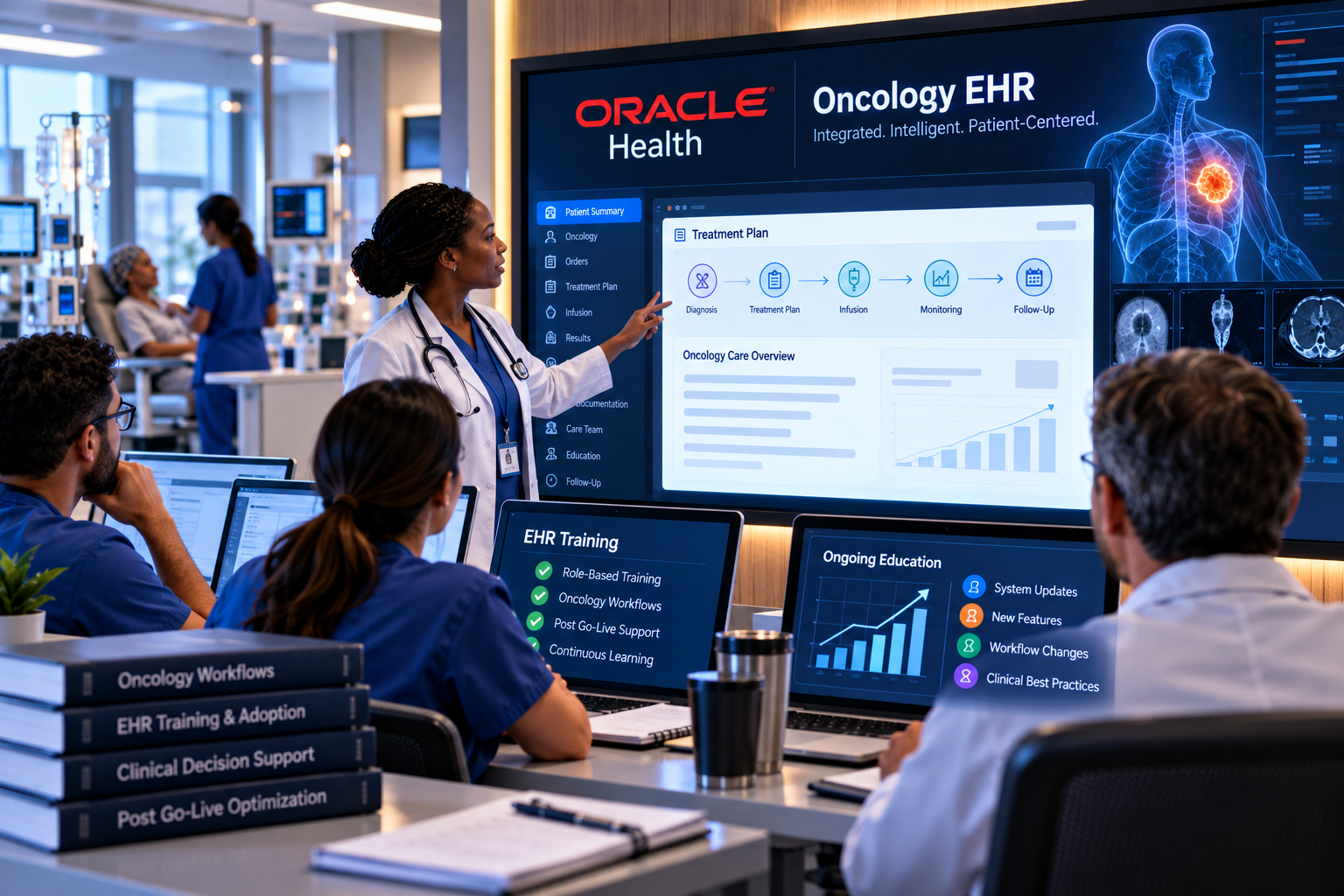
Oracle has unveiled a new oncology EHR built on its AI-powered ambulatory platform, combining specialty workflows with connected patient information, clinical decision support and embedded AI agents designed specifically around cancer care.
That is important technology news.
But for hospitals and clinical teams, it creates an equally important operational question:
How do you prepare thousands of healthcare professionals for an EHR that no longer stays functionally static after implementation?
That may become one of healthcare IT’s biggest challenges over the next several years.
Oracle Is Building AI Directly Into the Oncology Workflow
According to Becker’s Hospital Review, Oracle Health introduced its oncology-focused EHR at the Oracle Health and Life Sciences Summit in Orlando.
The platform is designed to support oncology care from diagnosis through treatment and follow-up, across inpatient and outpatient settings. Oracle says it combines oncology workflows, information from multiple data sources, connected patient records and AI-driven clinical intelligence.
An AI-powered assistant for oncologists is expected to create patient snapshots and pre-visit summaries, help clinicians prepare for tumor boards, support guideline-grounded treatment planning and carry clinical decisions into downstream activities including orders, referrals, documentation and coding.
Think about what that means from a workflow perspective.
A traditional EHR implementation might teach a provider:
Where do I find the patient’s information?
Where do I document?
How do I enter the order?
How do I send the referral?
How do I complete the encounter?
An AI-enabled EHR introduces another layer:
What did the AI summarize?
Where did that information come from?
What should I review before acting on it?
How do I modify the recommendation?
What happens after I accept it?
Which parts of the workflow are automated?
Where does clinician responsibility begin and end?
That changes the nature of EHR proficiency.
Healthcare Is Moving From EHR Navigation to EHR Collaboration
The first generations of EHR training were largely navigation-based.
Users learned where things were located and how to complete required tasks.
That is still necessary.
But the emerging EHR environment requires something more sophisticated.
Clinicians will increasingly interact with software that can interpret information, summarize records, suggest actions and initiate parts of workflows.
Oracle’s oncology platform is part of a broader trend.
Becker’s recently described the EHR as becoming healthcare AI’s “front door” as major vendors embed AI tools directly into the systems clinicians already use.
Oracle has also launched a clinical AI agent for nurses that operates inside its EHR. The nursing tool includes voice-enabled charting, patient information search and acute nursing summaries intended to help nurses understand a patient’s history and condition and complete documentation closer to real time.
Oracle previously introduced an AI agent for physicians and has expanded the technology into areas such as AI-assisted chart review, clinician-controlled dictation and coding support.
This is not an isolated product feature.
It represents a fundamental shift in how clinicians will interact with healthcare technology.
The EHR is becoming less like a digital filing system and more like an active participant in the workflow.
That Creates a New Training Problem
Imagine a hospital preparing for a conventional EHR go-live.
Employees complete training before launch.
Super users are identified.
At-the-elbow support teams arrive.
A command center opens.
The system goes live.
After several weeks or months, the organization gradually transitions from implementation mode into normal operations.
That model assumes that the workflows users learned before go-live will remain relatively stable.
AI challenges that assumption.
An AI-enabled EHR can gain new capabilities without requiring the organization to replace the underlying platform.
A documentation tool may be introduced.
Then automated summaries.
Then nursing agents.
Then coding assistance.
Then specialty-specific workflows.
Then new decision-support capabilities.
Each addition changes how someone performs a job they may already believe they know how to perform.
That means EHR education increasingly becomes continuous.
Oncology Makes the Challenge Even More Important
Cancer care demonstrates why this matters.
Oncology workflows are not simple, linear transactions.
A patient’s care may involve oncologists, surgeons, radiologists, pathologists, pharmacists, nurses, genetic counselors and other specialists.
Treatment decisions can depend on pathology, imaging, laboratory results, molecular testing, medications, previous therapies, comorbidities and evolving clinical guidelines.
Information accumulates longitudinally.
The patient’s story becomes more complicated over time.
An AI assistant capable of organizing that information could reduce cognitive and administrative burden.
But introducing AI into such an environment also means clinicians must understand the technology well enough to use it appropriately.
The challenge is no longer simply:
“How do I use Oracle Health?”
It becomes:
“How do I use this specific Oracle Health oncology workflow, with these AI capabilities, in this clinical scenario?”
That difference matters enormously for healthcare training and support.
Static Training Materials Will Struggle to Keep Up
Healthcare organizations have traditionally relied heavily on training manuals, tip sheets, classroom sessions, videos and internal knowledge bases.
Those resources remain useful.
But static documentation has an obvious weakness in a rapidly changing EHR environment.
It becomes outdated.
If a workflow changes but the tip sheet does not, users may receive inaccurate guidance.
If a new AI feature appears, employees may not understand it.
If functionality differs between specialties, generic training materials may provide an incomplete answer.
If someone joins the organization months after implementation, they may inherit a collection of documentation created during several different phases of the deployment.
This is one reason healthcare organizations should begin treating EHR workflow knowledge as living infrastructure rather than a collection of training documents.
Users need access to current guidance at the moment the question occurs.
The Question Is No Longer Just “Can the EHR Do This?”
As AI capabilities spread across EHR platforms, health systems should begin asking a different set of questions.
Do clinicians know the feature exists?
Healthcare organizations frequently invest in technology that employees underuse simply because users do not know what is available.
Do clinicians understand how it changes their workflow?
Adding AI to a process does not automatically make the process intuitive.
Can users get help while they are working?
A clinician encountering a new function during a busy clinic session cannot always leave the workflow to search through training materials.
Can the organization keep guidance synchronized with system changes?
Continuous software evolution requires continuous knowledge maintenance.
Can support teams identify where users are repeatedly struggling?
Recurring questions can reveal where additional training, configuration or optimization is needed.
These questions should become part of the AI deployment conversation.
AI Does Not Eliminate the Need for EHR Support
There is an understandable temptation to assume that smarter software eventually eliminates the need for training.
It may actually do the opposite.
AI can make software easier to use while simultaneously making the underlying workflow more sophisticated.
Consider a clinical AI assistant that produces a summary.
The clinician no longer needs to manually search through dozens of notes.
That is easier.
But now the clinician needs to understand how to verify the summary, how the system uses the information, where the original source data can be reviewed and what happens when the AI-generated output is incorporated into clinical documentation or downstream actions.
Convenience and complexity can exist at the same time.
That is why human readiness will remain critical.
This Is Where the Go-Live Model Must Evolve
The traditional idea of a “go-live” suggests a major beginning followed by gradual stabilization.
That concept still applies to large implementations.
But AI is creating smaller go-lives continuously.
A new agent may effectively represent a new workflow launch.
A major upgrade can alter how clinicians document.
A new specialty module can change an entire department’s processes.
An organization activating ambient documentation may need to retrain users even though the underlying EHR has been running for years.
A new AI search capability can change how clinicians retrieve information.
The future may therefore require healthcare organizations to operate with a state of continuous go-live readiness.
Training, support and optimization become ongoing capabilities rather than temporary implementation activities.
GoLiveX and the Continuous EHR Learning Model
This evolution closely matches the problem GoLiveX is designed to address.
GoLiveX provides AI-powered workflow guidance for healthcare professionals working across major EHR environments including Epic, Oracle Health/Cerner and MEDITECH.
The objective is not to replace formal training, implementation teams, analysts or at-the-elbow specialists.
It is to extend their knowledge.
Instead of requiring a user to remember every workflow learned during training, the user can seek guidance when the workflow is actually needed.
Instead of treating support as something available only during implementation, healthcare organizations can make workflow assistance available throughout the lifecycle of the EHR.
And because GoLiveX is designed for workflow guidance without requiring protected health information, the focus remains on helping users understand the system rather than analyzing an individual patient’s record.
That distinction becomes increasingly important as AI expands throughout healthcare.
The EHR Is Becoming an Intelligent Workspace
Oracle’s oncology announcement is significant because it provides another glimpse of what the EHR is becoming.
Not simply a repository.
Not simply a documentation tool.
Not simply a billing engine.
An intelligent clinical workspace.
The same transformation is happening across healthcare technology.
Epic is expanding AI throughout its ecosystem.
Oracle is developing clinical AI agents for physicians, nurses and specialty workflows.
Health systems are building their own agents around EHR data and operational processes.
Twenty-five health systems recently participated in an Epic initiative to build AI agents for clinical and operational workflows, another indication of how rapidly this environment is developing.
The direction is becoming clear.
The harder question is whether healthcare organizations can prepare their people as quickly as vendors can develop the technology.
The Next EHR Challenge Is Adoption at the Speed of AI
Hospitals have already learned an expensive lesson from decades of healthcare IT implementations:
Installing technology does not guarantee adoption.
And adoption does not guarantee proficiency.
AI does not change that equation.
It raises the stakes.
As systems such as Oracle Health introduce increasingly intelligent clinical workflows, successful deployment will depend on more than whether the software functions correctly.
Healthcare organizations will need clinicians who understand what changed, how the new workflow works and where to get immediate help when they do not know the answer.
That means the future of EHR implementation cannot end with training before go-live.
It must include continuous learning after go-live.
Oracle’s new oncology EHR may be designed specifically for cancer care, but the message extends far beyond oncology.
The EHR is becoming intelligent.
Now healthcare’s training and support infrastructure has to become intelligent too.
About GoLiveX
GoLiveX is an AI-powered EHR workflow guidance platform designed to help healthcare professionals navigate Epic, Oracle Health/Cerner, MEDITECH and other clinical systems. GoLiveX provides on-demand workflow guidance without requiring protected health information, helping clinicians, trainers and healthcare support teams access EHR knowledge during implementation, go-live, stabilization, optimization and everyday clinical use.
SEO Publishing Block
Recommended SEO Title:
Oracle Health’s AI Oncology EHR Shows Why Continuous EHR Training Is the Next Challenge
URL Slug:
oracle-health-ai-oncology-ehr-continuous-training
Primary / Focus Keyword:
AI EHR training
Secondary / Related Keywords:
Oracle Health EHR, Oracle Health AI, Oracle Clinical AI Agent, Cerner AI, EHR workflow training, AI clinical workflows, EHR adoption, EHR workflow support, healthcare AI training, continuous EHR training, clinician EHR support, oncology EHR, EHR optimization, AI-powered EHR
Meta Description:
Oracle Health’s new AI-powered oncology EHR shows how embedded clinical AI is changing EHR workflows and why hospitals need continuous training and workflow support beyond go-live.
Recommended Category:
AI & EHR Innovation
Suggested Tags:
Oracle Health, Cerner, Clinical AI, EHR Training, Oncology, Healthcare AI, EHR Workflows, EHR Optimization, Clinical Informatics, GoLiveX
Suggested Social Headline:
The EHR Is Learning New Skills Faster Than Clinicians Can Be Trained. That Is Healthcare’s Next IT Problem.
Source Story:
Becker’s Hospital Review, “Oracle Health unveils oncology EHR with AI-driven cancer care tools,” published September 24, 2026.
Leave a Reply