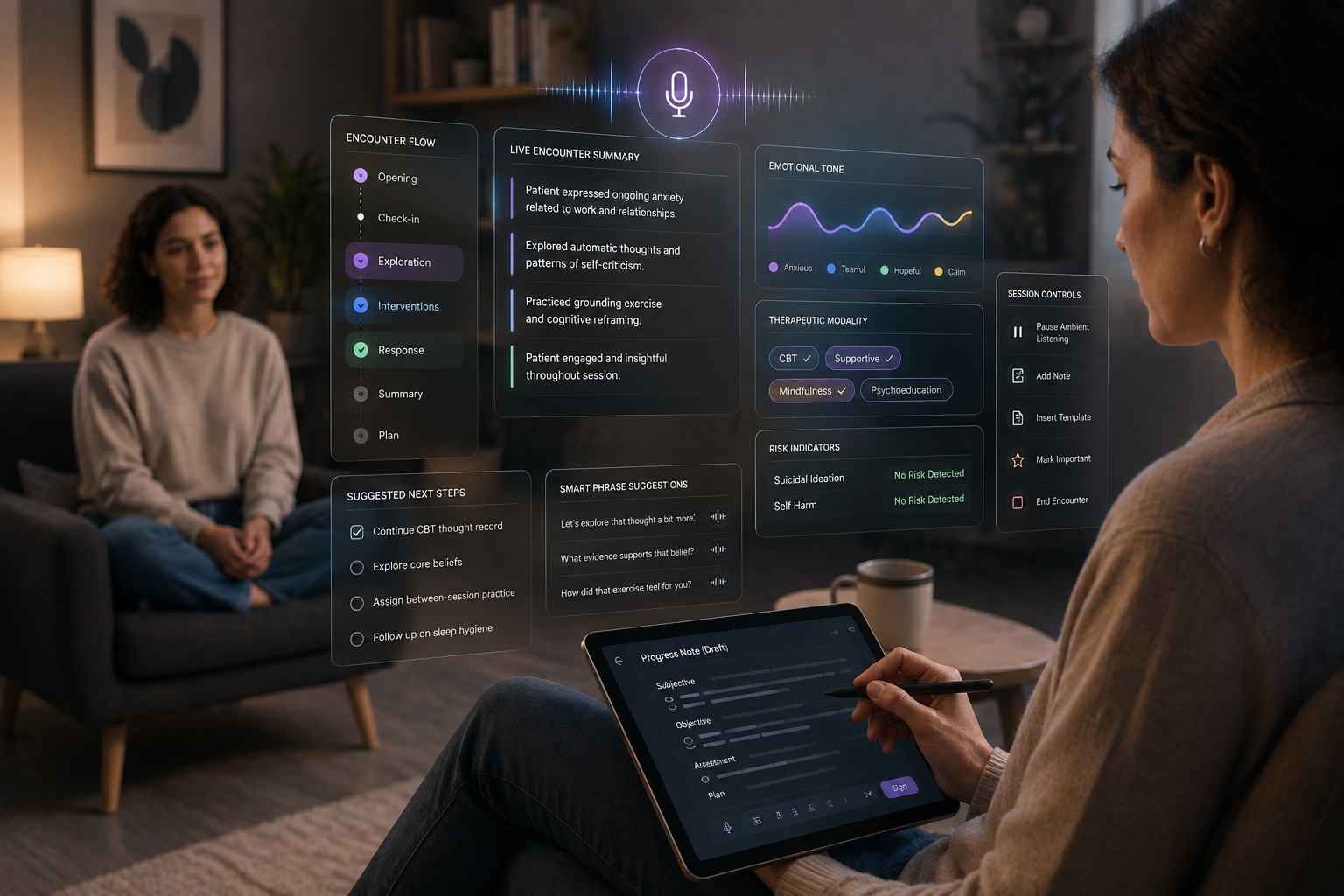
Documenting behavioral health encounters presents a fundamentally different challenge than charting physical medical visits. While general clinical consultations follow structured diagnostic paths (e.g., symptom assessment, physical exam, lab orders), psychotherapeutic and psychiatric encounters are deeply conversational, non-linear, and emotionally nuanced.
First-generation ambient voice scribes designed for physical medicine often fail in mental health settings. They struggle to extract clinical meaning from long therapeutic dialogues, frequently missing subtle mental status cues while failing to organize narrative patient histories into structured behavioral health notes.
To address these specialized needs, psychiatric clinics and outpatient behavioral health networks are adopting Ambient Voice Workflows designed for Behavioral Health. These platforms utilize domain-specific Natural Language Processing (NLP) models capable of synthesizing non-linear dialogue into standardized psychiatric documentation formats.
Structuring Non-Linear Narrative Dialogue
Mental health consultations require translating hour-long therapeutic discussions into precise, objective clinical documentation without losing critical longitudinal context.
[Unstructured 50-Minute Therapy Encounter]
│
▼
[Behavioral Health NLP Parser]
│
(Extracts Themes, Risk Factors, & MSE Cues)
│
▼
[Structured Psychiatric Note (DSM-5 / Mental Status Exam)]
Feature Comparison: Standard Medical Scribes vs. Behavioral Health Ambient AI
| Workflow Element | Standard Medical Ambient Scribe | GoLiveX Behavioral Health Ambient AI |
| Dialogue Parsing | Optimized for short, problem-focused physical symptom exchanges. | Optimized for long-form, non-linear therapeutic interactions and open narratives. |
| Mental Status Exam (MSE) | Basic observation or completely omitted from note structures. | Automated extraction of mood, affect, thought process, speech pace, and orientation cues. |
| Risk Assessment Tracking | Relies on explicit verbal confirmation of physical symptoms. | Detects subtle risk markers, flagging self-harm or suicidal ideation context for review. |
| Documentation Standards | Standard SOAP note output (Subjective, Objective, Assessment, Plan). | Flexible support for specialized formats including BIRP, DAP, and DSM-5 diagnostic codes. |
Primary Clinical Benefits for Mental Health Providers
- Automated Mental Status Exam (MSE) Summaries: The platform continuously analyzes speech cadence, emotional vocabulary, and thought organization to pre-populate objective MSE sections.
- Longitudinal Behavioral Trend Analysis: By mapping notes over time, clinicians gain clear visual insights into patient progress, tracking shifts in depressive symptoms, anxiety scores, and treatment adherence across months.
- Restored Clinician Presence: Eliminating manual note-taking during therapy sessions allows behavioral health professionals to maintain uninterrupted eye contact and build stronger therapeutic rapport with patients.
Key Takeaways
- Specialized NLP Requirements: Behavioral health charting demands ambient speech models tuned for long-form, non-linear, and emotionally rich patient dialogue.
- Automated Mental Status Documentation: Specialized AI translates verbal and tonal conversation markers into structured, objective Mental Status Examination summaries.
- Support for Behavioral Frameworks: Native alignment with BIRP, DAP, and DSM-5 reporting structures simplifies administrative compliance for mental health networks.
- Enhanced Therapeutic Rapport: Removing bedside charting friction allows mental health providers to focus completely on patient engagement and care delivery.
Leave a Reply