Category: News

  • Indiana hospitals under mounting strain as median margins fall to 1.9%

    Indiana hospitals under mounting strain as median margins fall to 1.9%

    Hospitals across Indiana are experiencing growing financial pressure, with median operating margins dropping to 1.9% in 2025 well below the national median of 2.6%. The findings come from a Kaufman Hall analysis conducted for the Indiana Hospital Association, which represents more than 160 hospitals statewide.

    According to the report, Indiana hospitals saw operating income decline by $50 million compared to the previous year, a 5.5% drop that has reduced funds available for patient care, capital investments, and facility upgrades. At the same time, emergency department visits surged by nearly 17%, far outpacing the national increase of about 1.4%.

    Indiana Hospital Association President Scott Tittle noted that hospitals are facing overlapping challenges, including workforce shortages, rising labor expenses, inflation-driven increases in supply and utility costs, and reimbursement rates from Medicare and Medicaid that fall well short of the actual cost of care. He added that hospitals are simultaneously being asked to expand investments in access, quality initiatives, behavioral health, workforce development, and rural services.

    The analysis also showed expenses growing faster than revenue. Operating costs rose 4.7% while revenue increased only 4%. Labor costs climbed 4.2% despite hospitals cutting their use of high-cost contract labor by nearly half. Non-labor costs increased even more sharply, with medical supply expenses rising 6.8% and purchased services jumping over 9%.

    Kaufman Hall Managing Director Erik Swanson explained that these trends reflect the growing complexity of care delivery, particularly as hospitals manage higher patient acuity and aging populations.

    Some hospitals are feeling the strain more acutely. Methodist Hospitals in Gary, Indiana where roughly 80% of patients rely on government insurance reported losing $27 million in federal disproportionate share funding over the past three years. Leadership there highlighted that Medicaid currently reimburses only about 57 cents per dollar of care, while Medicare covers roughly 82 cents. State Medicaid base rates, according to association leaders, have not been meaningfully increased in decades and face further reductions under the One Big Beautiful Bill Act.

    Financial pressures are also driving service reductions. Greene County General Hospital announced the closure of its obstetrics unit after more than a century of operations, citing unsustainable costs tied to low reimbursement and reliance on contract physicians. The decision aligns with a broader national pattern of maternity care closures.

    At Baptist Health Floyd in New Albany, hospital leaders reported adding beds to meet rising demand, yet still posted a negative operating margin of 3.7% in fiscal 2025, resulting in a $16.1 million loss. Despite higher patient volumes, leadership said continued cost pressures have forced difficult decisions about service reductions and efficiency efforts.

    Looking ahead, Kaufman Hall simulations suggest that without policy or funding changes, Indiana hospitals could collectively face nearly $1 billion in annual losses within the next three to five years, potentially pushing statewide operating margins into negative territory.

    Healthcare leaders warned that if current trends persist, access to care across Indiana could become increasingly difficult to sustain. They emphasized that meaningful reform particularly around Medicaid reimbursement and broader insurance policy will be critical to protecting patient access statewide.

    Source: Becker’s Hospital Review 

    Madeline Ashley (analysis based on Kaufman Hall data for the Indiana Hospital Association)

  • Healthgrades names America’s top hospitals for 2026

    Healthgrades names America’s top hospitals for 2026

    Healthgrades released its annual America’s Best Hospitals Awards on January 27, highlighting 250 hospitals nationwide for outstanding clinical performance.

    The rankings identify the top 50, 100, and 250 hospitals, representing the leading 1%, 2%, and 5% of U.S. hospitals for clinical excellence. To determine the results, Healthgrades evaluated clinical outcomes from approximately 4,500 hospitals, analyzing performance across 30 common procedures and conditions using Medicare data spanning 2022 to 2024. Detailed methodology is available through Healthgrades.

    According to Healthgrades’ analysis, if all U.S. hospitals delivered care at the same level as the top 250 performers, an estimated 211,000 lives could be saved each year.

    Top 50 Hospitals in the U.S. for 2026 (Healthgrades)

    Arizona

    • Mayo Clinic Hospital (Phoenix)

    California

    • Mills-Peninsula Medical Center (Burlingame)
    • Cedars-Sinai Medical Center (West Hollywood)
    • Sutter Roseville Medical Center (Roseville)
    • Northridge Hospital Medical Center (Northridge)
    • Providence Holy Cross Medical Center (Mission Hills)
    • Stanford Hospital
    • Scripps Memorial Hospital Encinitas
    • Alta Bates Summit Medical Center (Oakland)
    • Scripps Mercy Hospital San Diego

    Colorado

    • HCA HealthONE SKY Ridge (Lone Tree)

    Connecticut

    • Norwalk Hospital

    Florida

    • Mayo Clinic (Jacksonville)
    • AdventHealth Orlando
    • Cape Coral Hospital
    • Naples Community Hospital
    • Lee Memorial Hospital (Fort Myers)
    • HCA Florida Kendall Hospital (Miami)
    • Gulf Coast Medical Center (Fort Myers)

    Georgia

    • Emory University Hospital Midtown (Atlanta)
    • Emory St. Joseph’s Hospital (Atlanta)

    Illinois

    • Advocate Lutheran General Hospital (Park Ridge)

    Maryland

    • Johns Hopkins Bayview Medical Center (Baltimore)

    Michigan

    • Beaumont Hospital, Troy
    • Ascension Providence Hospital–Southfield Campus

    Minnesota

    • Mayo Clinic Hospital, St. Marys Campus (Rochester)
    • Mayo Clinic Health System Mankato

    North Carolina

    • Mission Hospital (Asheville)

    New Jersey

    • Atlantic Health Morristown Medical Center
    • Atlantic Health Overlook Medical Center (Summit)

    New York

    • Vassar Brothers Medical Center (Poughkeepsie)
    • Lenox Hill Hospital (New York City)
    • Stony Brook University Hospital
    • NYU Langone Hospitals (New York City)

    Ohio

    • Mercy Health-Fairfield Hospital
    • The Jewish Hospital–Mercy Health (Cincinnati)
    • Mercy Health–West Hospital (Cincinnati)
    • Akron City Hospital
    • Mercy Health–St. Elizabeth Youngstown Hospital

    Pennsylvania

    • Lancaster General Hospital
    • Lankenau Medical Center (Wynnewood)
    • Chester County Hospital (West Chester)
    • Reading Hospital
    • St. Luke’s Hospital–Bethlehem Campus
    • Riddle Memorial Hospital (Media)
    • Milton S. Hershey Medical Center (Hershey)

    Texas

    • Houston Methodist Hospital

    Virginia

    • Inova Loudoun Hospital (Leesburg)

    Washington

    • EvergreenHealth Medical Center–Kirkland

    West Virginia

    • Cabell Huntington Hospital

    Source: Becker’s Hospital Review 

     Erica Cerutti (based on Healthgrades’ America’s Best Hospitals Awards 2026)

  • California hospital to eliminate 265 roles amid funding pressures

    California hospital to eliminate 265 roles amid funding pressures

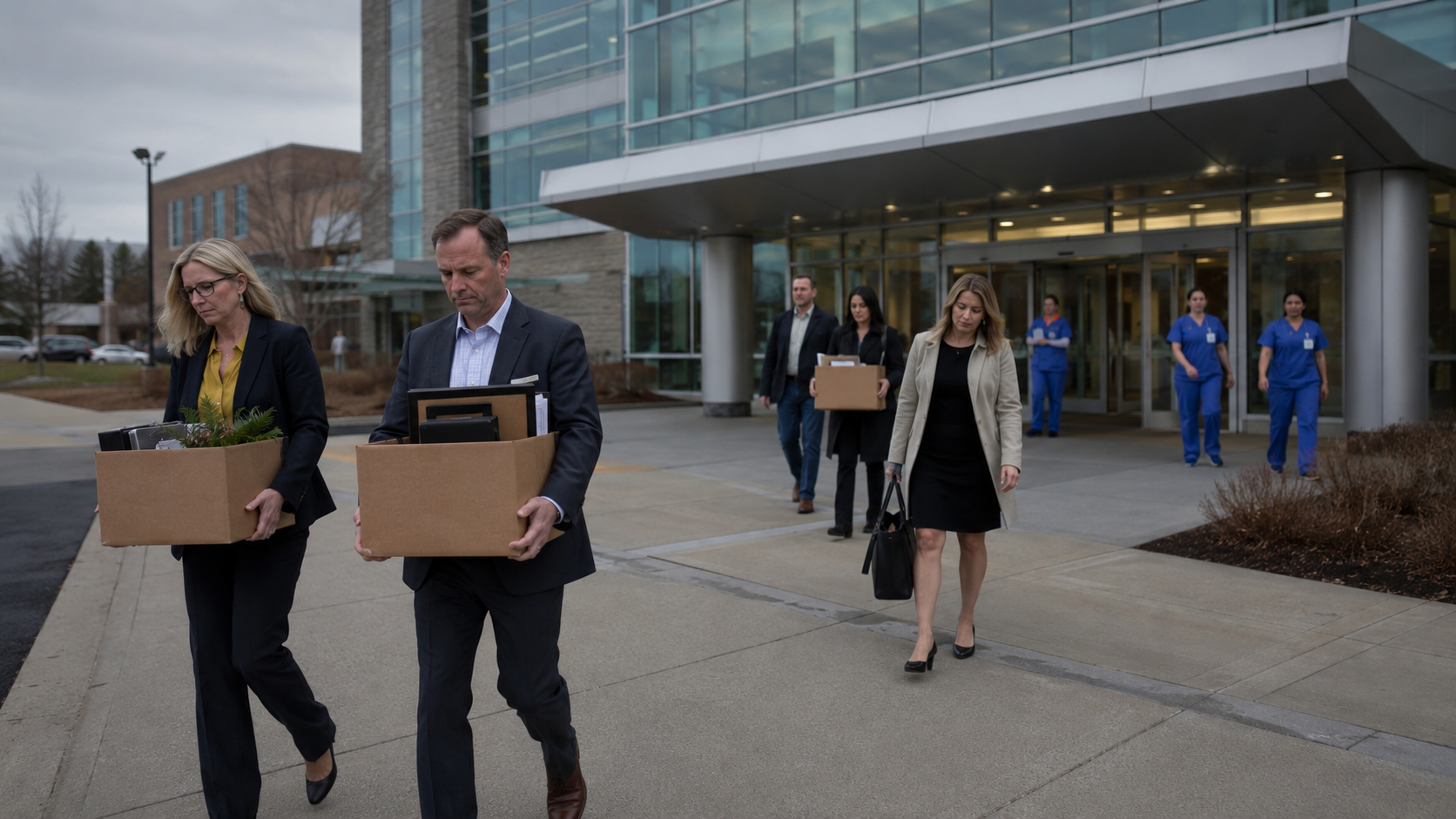
    Pomona Valley Hospital Medical Center in Pomona, California, has announced plans to reduce its workforce by 265 positions due to significant reductions in state and federal funding. The decision, revealed on January 7, is part of efforts to manage financial strain while continuing to provide patient care.

    The hospital, which employs over 3,500 staff members, stated that 128 of the affected positions will be phased out through natural attrition and scheduled retirements within the year. The remaining 137 roles will be impacted through layoffs and reduced working hours, with workforce changes expected to be completed by March 8, according to a WARN notice.

    Hospital leadership attributed the financial shortfall largely to HR1 also known as the One Big Beautiful Bill Act which led to lower Medi Cal reimbursement rates and reductions in the California Hospital Quality Assurance Fee that supports safety-net hospitals. As a result, the hospital’s projected revenue for 2025 declined by approximately $40 million without corresponding cost relief.

    Employees affected by the cuts will be offered severance packages, unemployment support, career transition services, and continued access to medical benefits. The hospital has also introduced a voluntary separation program and encouraged displaced staff to apply for available internal positions. Hospital President and CEO Richard Yochum expressed regret over the decision, noting that similar financial challenges are affecting healthcare organizations nationwide and that advocacy efforts are ongoing to protect critical funding.

    Source: Becker’s Hospital Review: Kelly Gooch

  • America’s Hospitals Are Rewriting Themselves One EMR Upgrade at a Time

    America’s Hospitals Are Rewriting Themselves One EMR Upgrade at a Time

    This isn’t an IT project. It’s a survival story.

    There is a tremor beneath American healthcare, a shift so fundamental it will touch every life that walks into a hospital. In 2026, EMR systems are no longer just digital filing cabinets. They are the heart of care. They carry histories, track emergencies, support deep contextual decisions, and, increasingly, share intelligence across systems.

    This year, a new wave of EMR modernization is sweeping the U.S. North of community clinics and deep into urban trauma centers. Part of this movement is technical  AI assisted documentation that significantly reduces charting burden, pre populates clinical histories, and offers predictive problem lists.

    But under the surface, what’s happening is deeply human.

    Clinicians  exhausted by burnout and long after-hour documentation  are finding relief in systems that auto-suggest progress notes, echo the physician’s voice, and surface contextual reminders before a mistake becomes harmful. Practices are integrating telemedicine into standard scheduling workflows so that hybrid care feels less like a patchwork and more like continuity.

    The costs have been real and at times painful. Some modernization efforts  such as the VA’s multi-billion dollar EHR expansion  have exposed how costly and delicate these transitions can be, with staff flagging dangerous errors and care delays that have even, tragically, harmed patients.

    These stories are not warnings against modernization. They are reminders of how sacred this work really is. The EMR is not a software product, it is the ledger of a life. When it falters, people feel it. When it succeeds, care becomes a continuum instead of a series of fragmented moments.

    Across the U.S., leaders are approaching EMR adoption with renewed humility. They understand that:

    • Every click becomes part of a patient’s story
    • Every downtime is a chance to rethink resilience
    • Every interface rewrite is an opportunity to reduce burnout

    Data today is no longer just a record of the past, it is a live thread connecting every shift, every referral, and every handoff.

    In that context, the EMR renaissance of 2026 is not a change in technology, it’s a change in how hospitals remember and respond. And every life touched by it carries a different kind of heartbeat  steadier, more coherent, and more human.

  • After the Click: Measuring the Quiet Returns of a Successful EMR

    After the Click: Measuring the Quiet Returns of a Successful EMR

    The dashboard glows. But what we truly measure is minutes returned to the bedside.

    Organizations obsess over go live dates and ticket counts. Those metrics matter, but they miss the soft dividends: minutes that clinicians reclaim, conversations that aren’t cut short by forms, and fewer repeat histories. After the click, the real question is, how much more human are we able to be?

    A hospital we worked with tracked a small but telling metric: bedside time per patient. After targeted workflow optimization in the months following go live, bedside time rose by an average of seven minutes per patient small in isolation, massive in aggregate. Nurses reported more opportunities to educate families; clinicians reported fewer after-shift hours spent reconciling charts.

    Meaningful post go live metrics

    • Minutes at bedside per patient (tracked via timed observations or proxy measures).
    • Repeat history calls (how often patients have to repeat their story).
    • After-shift charting hours (time clinicians spend finishing notes off the clock).
    • Clinician burnout & satisfaction scores.
    • Time from lab result to action (how quickly care follows data).

    Turning metrics into practice

    • Set baseline measures before go-live so gains are visible.
    • Tie sprint goals to human metrics (reduce after-shift charting by X minutes).
    • Celebrate wins and iterate on losses Small, continuous improvements beat one big overhaul.
    • Share stories alongside numbers: one extra minute at the bedside can mean one held hand.

    After the click, the charts should free clinicians to be clinicians. Track the quiet returns and ensure your success is measured not only in uptime but also in the reclaimed minutes that let care breathe.

  • Data Midwives: Bringing Legacy Records Safely into the New World

    Data Midwives: Bringing Legacy Records Safely into the New World

    Migrating charts is like delivering a history handle gently, or you lose the story.

    Legacy data is messy and dear. It contains the old scar notes, the one nurse’s shorthand that matters, and the allergy a parent insisted on recording in the margins. Migrating that history is like midwifing a past into a new life: you must preserve the meaning, not only the bytes.

    At a midwestern health system, a rushed migration stripped narrative fields down to CSVs. Post go live, clinicians lamented that lost context notes that had contained instructions about at-home caregiving were gone. Recovery cost weeks of reconciliation and immeasurable trust. We learned: data migration is not a back-end task; it is clinical stewardship.

    Migration practices that honor stories

    • Classify data by clinical value. Not all fields travel equally. Identify what must move verbatim (allergies, advanced directives) versus what can be summarized.
    • Create a living archive. Keep an accessible snapshot of legacy views for a defined period and teach clinicians how to read them.
    • Involve clinicians in mapping. Clinician review prevents translating nuance into noise.
    • Automate quality checks, then spot-check with humans. Run reconciliation reports and have domain experts validate samples.

    Migration checklist

    • Inventory data sources and annotate clinical value.
    • Run a dry-run migration and present clinicians with before/after stories.
    • Build a reconciliation forum where clinicians can request targeted legacy recoveries.
    • Preserve free text narratives as read-only archives for a defined phase post-go-live.

    Data midwifery is about respect. When you carry a history forward with care, clinicians keep the thread of a life intact, and that continuity is medicine.

  • Downtime as Design: Planning for the Moments When Systems Fail

    Downtime as Design: Planning for the Moments When Systems Fail

    True resilience shows when everything shatters; what happens next reveals your system’s soul.

    We tell ourselves that downtime is a rare beast, an exception. Then it happens at 3 a.m. on a snowy Tuesday, and you learn which plans were sketches and which were muscle. Downtime is not an emergency to be endured; it’s a design problem to be rehearsed.

    At Mercy North, a sudden network partition knocked out access to the central EMR for ninety minutes. The team activated a practiced plan: paper-lite quick forms, a sync queue on portable tablets, and a single coordinator who triaged phone requests. Nothing dramatic, no lives lost, but the difference was felt in the smoothness of handoffs and the quiet confidence of staff who had practiced the ritual.

    Make downtime a ritual

    • Design degraded workflows, not just backups. Paper based fallbacks should mirror the data you truly need in a crisis (allergies, current meds, code status), not full charts.
    • Test, test, and test again. Live drills with clinicians reveal the real failure modes. Time the drills; measure reconciliation time afterward.
    • Create reconciliation tools that aren’t painful. Offline entries should sync and reconcile without duplicating work or losing narrative context.
    • Communicate widely and kindly. Staff and families need clear, calm updates. Treat transparency as a clinical duty.

    A simple downtime play

    1. Pre-pack bedside “critical info” cards for every inpatient.
    2. Train two people per unit to run manual med reconciliation.
    3. Run quarterly simulated outages and record time-to-safe state.
    4. After each drill, run a blameless post-mortem and publish one fixable change.

    Downtime reveals compassion under pressure. Treat it as a design problem, and your hospital’s humanity will show up in the dark.

  • The GoLive Lullaby: How Hospitals Learn to Sing Together

    The GoLive Lullaby: How Hospitals Learn to Sing Together

    Go live isn’t a deployment; it’s a hospital learning a new lullaby to soothe its patients.

    There is a hush the day before a go-live: cables taped, printers aligned, and staff badges blinking with new access. For weeks the hospital has rehearsed this moment  checklists, training sprints, late-night build calls  but the rehearsal is not ready. Real readiness is the moment a scared family member hears the right answer without a clinician fumbling, and that only happens when people and systems finally sing in the same key.

    At St. Clement’s, the first go-live wasn’t a headline; it was a lullaby. On Day One, a pediatric nurse named Marisol found that the new medication reconciliation screen finally put allergy flags beside the order. No more cross checking paper lists. She breathed, and for the first time that week, she sat with a mother long enough to answer a question about feeding, rather than chase a chart.

    Go lives are noisy, but they should leave patients in a calm. That’s the lullaby: routines that protect care, interfaces that support bedside work, and leadership that sings the same tune in every hallway.

    What made that lullaby possible

    • Pre go live rehearsals that included patients. Scripts, role plays, and simulated family calls.
    • Clinician champions on every shift. Trusted colleagues who answer “how,” not just “what.”
    • A staffed command center, not a control room. People available to fix workflow problems in real time, not just technical bugs.
    • Minimum viable scope at launch. Start with the workflows that move the most care, not every feature in the sprint backlog.

    Quick checklist

    • Run bedside simulations with representative staff one week before golive.
    • Publish a one-page “what to expect” for families and frontline staff.
    • Have a visible escalation path mapped to real people (names, not titles).
    • Schedule celebration moments to recognize the fatigue and the courage shown.

    When systems finally sing with humans, the lullaby is simple: it returns attention to the patient. That is the score by which all go-lives must be judged.

  • “The Upgrade Dilemma: What Happens When Your EMR Outgrows You or You Outgrow It?”

    “The Upgrade Dilemma: What Happens When Your EMR Outgrows You or You Outgrow It?”

    When systems shift, so must we. But what does migration truly cost?

    There’s a peculiar ache to outgrowing something you once loved. A clinic’s favorite EMR years of workarounds welded into workflows, secret shortcuts known to three nurses and one night-shift tech suddenly feels like an old coat: warm, familiar, but misshapen by time. And then there are the other moments, when the system itself has grown teeth and wings and is pulling the hospital forward without carrying everyone along. Either way, the decision to upgrade is not an IT project. It is a small funeral and a new birth rolled into one.

    The Quiet Signs You’ve Topped the Roof

    You feel it before you see it:

    the extra hour nurses spend charting after rounds, the surgeon’s frustrated mutter when images fail to load, the repeated question families ask because no one on shift can find a note. The EMR does not sing anymore; it coughs. Interoperability becomes mythology. Patches pile up like sediment. In that hush, the cost begins to whisper: missed time, delayed decisions, clinician burnout.

    What Migration Actually Costs (Not Just Dollars)

    1. Time  the currency of care

    Rollouts take months; go-lives take weeks of chaos. Training pulls clinicians from patients. That lost bedside time is the invisible toll that accrues into fatigue and missed moments of connection.

    2. Attention the fragile resource

    When screens demand your focus, your ears stop listening. Upgrades that change interfaces force clinicians back into learning mode, just when patients need presence most.

    3. Trust  the hardest to rebuild

    Every failed cutover, every lost result, chips away at confidence. Redeeming that trust costs far more empathy than a new server farm ever will.

    4. Stories institutional memory at risk

    Legacy systems hold oddities: a handwritten note transcribed decades ago, a rare allergy flagged in a way only one nurse remembers. Migrating data risks losing those small human cues unless you deliberately preserve them.

    5. Money  the headline, and only part of it

    Licenses, professional services, middleware, training, overtime, contingency staffing. The price tag multiplies when you factor in downtime, productivity loss, and the cost of fixing what wasn’t anticipated.

    6. Culture  the slow, soft work

    Change touches how teams speak to each other. Champions and skeptics surface. The migration becomes a test of leadership, communication, and shared purpose.

    What You Gain When the Upgrade Is Done Right

    • Time returned: streamlined workflows, fewer clicks, faster orders mean minutes that convert back into care.
    • Safer care: fewer duplicate meds, clearer allergies, sharper decision support.
    • Interoperability: data that follows the patient, not the building.
    • Scalability: a system that can grow with new services, telehealth, and advanced analytics.
    • Renewed morale: when systems feel like allies again, clinicians breathe easier.

    The benefits are not automatic. They arrive only when migration is treated as a human transition as much as a technical one.

    The True Costs You Can’t Put on the Purchase Order  and How to Guard Them

    Honor the stories. Keep a “living archive” of legacy quirks notes about why old templates existed, annotated examples of clinician hacks. Migrations that respect memory lose less meaning.

    Staff the human bridge. Assign clinical champions, not just project managers. These are people who can translate frustration into fixes at 2 a.m., and whose presence reassures teams.

    Train like you’re teaching a craft, not reading a manual. Micro-learning, bedside shadow shifts, and peer coaching beat one day classroom marathons. Learning must be incremental, embedded, repeated.

    Plan for degraded grace. Offline modes, printable summaries, and reconciliation queues keep care dignified when networks hiccup. Test those fallbacks until they feel like muscle memory.

    Measure things that matter. Track minutes at bedside, route times for critical labs, repeat-history calls, and clinician satisfaction then be willing to iterate on the results.

    Communicate as if you are tending a community. Regular honest updates, visible timelines, and space for real questions turn anxiety into alignment.

    The Migration as Moral Work

    Upgrading an EMR is moral work because it reshapes how people are seen. A better system can mean fewer repeated histories for a patient with dementia. It can mean faster antibiotic delivery for a septic child. It can mean a discharge summary that reads like a story instead of a riddle. These are the quiet moral returns that repay the cost of change.

    A Short Map for Leaders Who Must Choose

    1. Start with pain, not vendors. Map the workflows that hurt most.
    2. Pilot small, scale with care. Win the trust of teams with early, visible wins.
    3. Invest in people. Training, super-users, and well-resourced support lines are non-negotiable.
    4. Preserve memory. Migrate clinical context, not only codes.
    5. Test failure modes. Rehearse outages until fallback becomes habit.
    6. Measure the human ROI. Track bedside minutes and burnout alongside cost per chart.

    The Last, Tender Truth

    Letting go is never merely technical. It is emotional labor; it is honoring what the old system did for you while daring to expect more. There will be nights when the lights in the IT war room burn blue and everyone wonders if it was worth it. There will be mornings when a resident clicks a single button and finds a patient’s whole life laid out simpler, truer, kinder and then you will know.

    Upgrades cost. They cost in cash, in hours, in attention, in trust. But sometimes you pay that price to buy a different currency: time returned, errors avoided, hands freed to be human again.

    If your EMR is outgrowing you, or you are outgrowing it, choose not the easiest path but the one that honors people. Plan the migration as a passage, not a transaction. Keep hands in the room. Keep stories intact. And remember: when the last field is saved and the new screen breathes calm, what you’ve birthed is not just a system but a little more space for care.

  • The panic in an emergency room is never cinematic.

    The panic in an emergency room is never cinematic.

    It is the small, sharp things: a monitor spiking, a mother’s hand clenched white, a resident hunting for a prior allergy in a paper chart while a patient’s pulse thunders in the dark.

    In that small theater, seconds are not currency they are lifeblood. And that is where modern EMRs have learned to be surgical: not by replacing people, but by returning time to them.

    The First Breath: Triage That Knows Before You Ask

    A patient staggers in, words thin with shock. Before a nurse finishes the intake, the system has already matched vitals to risk profiles, suggested the most likely order set, and flagged the chart for rapid review. Triage becomes less about filling forms and more about feeling what matters. The EMR’s quiet suggestion preloaded pathways, smart defaults turns fumbling into action.

    Order Sets That Speak Medicine’s Language

    In the rush of a resuscitation, typing becomes a liability. Pre-approved, specialty tuned order sets let teams give the right meds, the right labs, the right imaging fast and with fewer keystrokes. The anesthetist doesn’t pause to navigate nested menus; the pharmacist already sees the alert and queues the drug. What used to take frantic minutes now happens in the time it takes to breathe once, twice.

    Alerts That Whisper, Not Shout

    A cascade of alarms used to mean paralysis: every beep demanding attention, none prioritized. Today’s smarter EMRs triage their own alarms, grouping, grading, and surfacing only the crisply urgent. Clinicians stop getting shouted at by machines; they get nudged by collaborators. The result: less noise, less fatigue, and more accurate responses when it truly counts.

    Interoperability: The Patient’s Story, Not a Puzzle

    Seeing a patient for the first time should not be a game of memory. When EMRs speak to labs, imaging, ambulance records, and prior visits even from a different system the clinician opens a single, coherent life story. No repeated histories. No missed allergies. Every handoff carries the same truth, and the next clinician starts where the last left off, not where the paperwork ended.

    Voice, Mobile, and the Bedside Return

    Hands that hold, mouths that soothe EMRs that listen. Voice-enabled charting, bedside tablets, and mobile access mean notes are created at the patient’s side, not after the shift. A nurse says what she sees; the chart reflects it. The physician sees a gaze instead of a cursor. Seconds saved here multiply into presence regained.

    Predictive Eyes That See the Storm Before It Breaks

    Predictive analytics don’t replace intuition; they amplify it. Subtle trends rising lactate, a drifting oxygen curve are flagged before they become crises. Those whispered warnings let teams intervene early: fluids started sooner, specialists called preemptively, beds readied faster. Prevention is the quietest rescue.

    Medication Safety: Barcode Kisses Goodbye to Error

    When every pill and infusion is scanned, cross-checked, and reconciled in a heartbeat, the risk of harm drops. The pharmacist’s green light, the nurse’s confirmation, the EMR’s instant audit, these small rituals protect patients in ways that feel almost invisible until pain is prevented.

    Tele-ED and Rapid Consults: Expertise on Tap

    Not every ER can staff every specialty at 2 a.m. Tele-consult integrations bring specialists into the room virtually, with imaging and labs already there on screen. Decisions that once waited hours can be made in a rapid conference faster diagnosis, faster transfer, faster treatment.

    The Human Measure: Seconds That Become Space to Care

    Numbers matter, but the true metric is softer: the nurse who stays an extra two minutes to hold a hand, the physician who listens to a patient’s fear because the charting was lighter, the family that gets clear answers without repeating a trauma. Seconds reclaimed are the currency of compassion.

    The Quiet Caveat: Design That Respects Rhythm

    This work is not automatic. EMRs must be built with humility, context aware, co-designed with clinicians, and relentlessly pruned of needless clicks. Alerts must be calibrated, interfaces simplified, downtime plans rehearsed. When technology is tuned to human rhythm, it becomes a partner. When it isn’t, it becomes another interruption.

    When time is bleeding, systems must be sharp. EMRs that cut through chaos do so not by making machines louder, but by teaching them to be useful in the hush: to prefill when it helps, to whisper when it must, to hand context to the people who finally have the space to use it.

    In emergency medicine, the smallest saved second can steady a breath, and a breath steadied is a life given a chance.