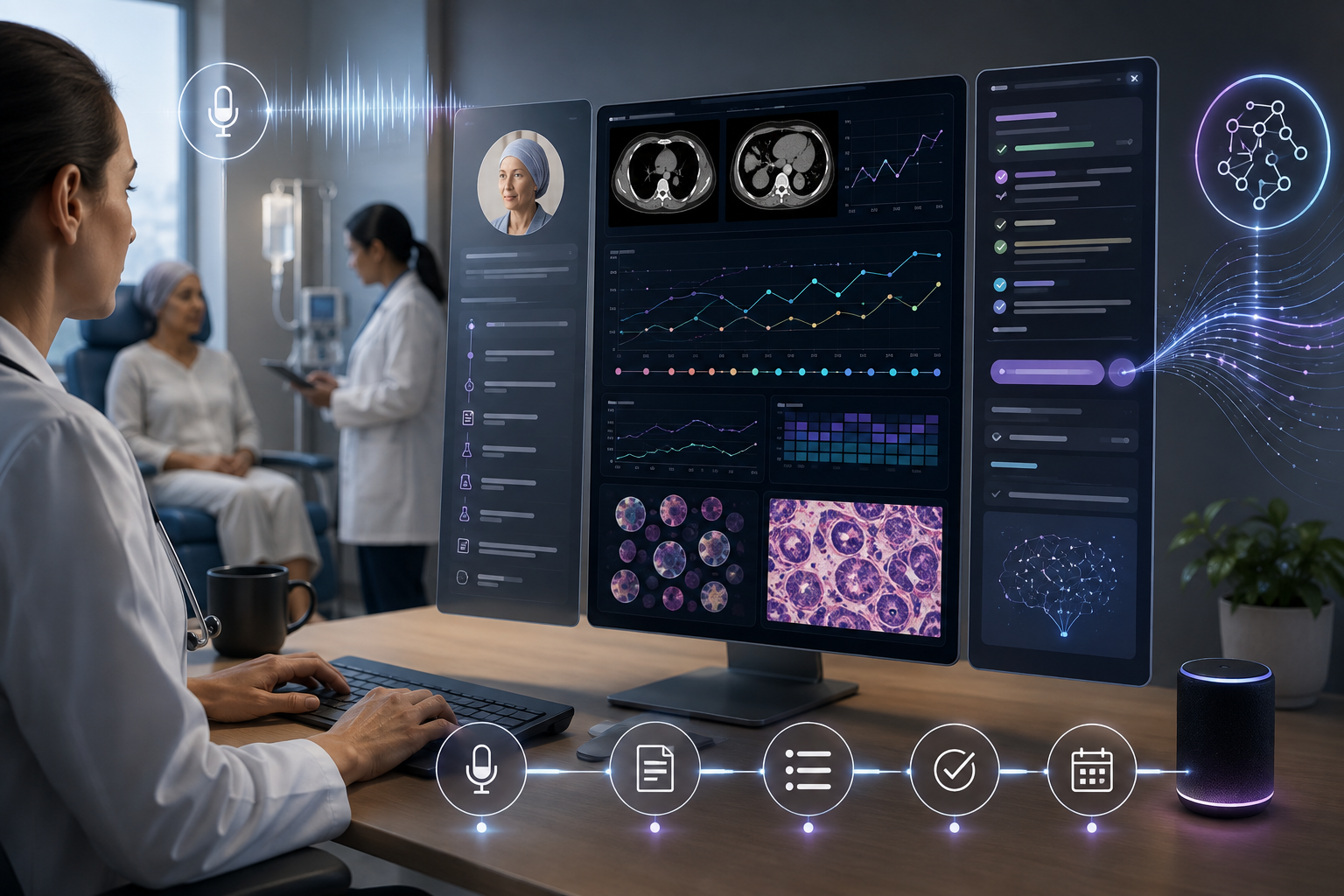
Documentation in specialized medical disciplines—particularly oncology—presents unique challenges for standard ambient documentation tools. Unlike routine primary care visits focused on immediate symptoms, an oncology consultation requires synthesizing multi-year patient histories, tracking complex chemotherapy protocols, interpreting genomic biomarker panels, and coordinating multi-specialty care plans.
First-generation ambient scribes often struggle with these complex environments. They generate basic SOAP notes focused only on the current consultation, ignoring past treatment lines, radiation summaries, and disease progression trends scattered across hundreds of historical EHR pages.
To address these needs, health systems are deploying specialized Ambient Clinical Intelligence (ACI) platforms for Oncology. These advanced platforms combine ambient voice processing with real-time longitudinal EHR data parsing, generating structured oncology notes that reflect the full arc of patient care.
Bridging the Gap: Primary Care Scribes vs. Longitudinal Oncology ACI
Understanding the structural differences between general ambient transcription and specialized longitudinal intelligence is critical for specialty care IT deployment.
[Primary Care Scribe] ──► Captures Current Audio ──► Generates Single Encounter Summary
[Oncology ACI Engine] ──► Captures Current Audio
│
├───► Integrates Historical EHR Data (Labs, Biopsies, Prior Regimens)
│
▼
[Generates Longitudinal Cancer Care Note]
Feature Comparison: Standard Scribes vs. Oncology-Specific ACI
Workflow Requirement
Standard Primary Care Scribe
Specialized Oncology Ambient AI
Data Scope
Single-encounter conversation.
Multi-year longitudinal history + live consultation context.
Oncology Vocabulary
Basic medical terminology; misses complex drug protocols.
Native mapping of TNM staging, biomarker markers, and NCCN clinical guidelines.
Treatment Tracking
Captures current medications discussed in the room.
Automatically tracks line-of-therapy history and cumulative drug dosage limits.
EHR Integration
Dumps unstructured narrative text into clinical notes.
Populates structured oncology flowsheets, tumor registry fields, and order templates.
Key Clinical Benefits in Specialized Care
Automated Staging & Biomarker Summaries: The platform parses pathology reports and genomic testing feeds to maintain auto-updated diagnostic summaries within the clinical record.
Line-of-Therapy Tracking: The system recognizes adjustments to chemotherapy, immunotherapy, or targeted therapy plans, mapping shifts against established treatment timelines.
Multi-Disciplinary Handoff Efficiency: By structuring documentation around longitudinal timelines, cancer care teams (surgical, medical, and radiation oncologists) access unified patient state overviews during tumor board reviews.
Key Takeaways
Specialty Complexity: Complex medical specialties require documentation tools that integrate multi-year historical data alongside live room audio.
Longitudinal Context: Oncology-specific ambient intelligence tracks disease progression, treatment lines, and biomarker data across long care journeys.
Structured Data Capture: Converting clinical conversations into structured EHR fields supports research, trial matching, and tumor registry reporting.
Reduced Provider Burden: Automating complex specialty documentation allows oncologists to focus on patient communication and care planning.
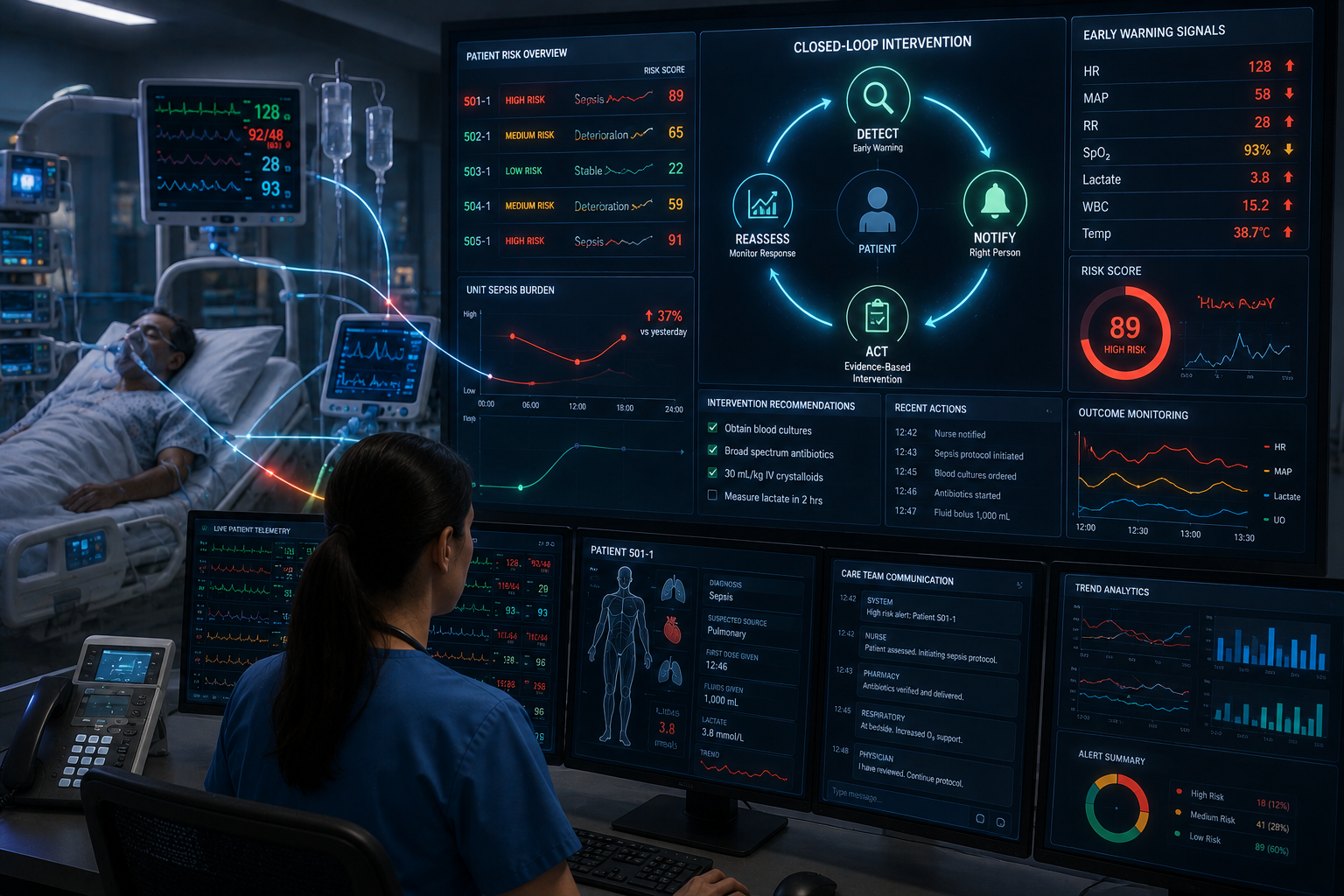
Patient deterioration in acute care settings—particularly in rapid-onset conditions like septic shock, acute respiratory distress, and cardiac distress—unfolds in minutes, not hours.
Despite widespread deployment of early warning scoring models within Electronic Health Record (EHR) systems, hospital staff still struggle with actionable alert delivery. First-generation risk models rely on static, scheduled batch queries that calculate patient risk every few hours. By the time a risk score crosses a critical threshold, clinical deterioration may already be well underway.
To close this life-saving gap, hospital systems are transitioning to Real-Time Closed-Loop Clinical Intervention Systems. By streaming continuous telemetry directly from bedside monitors, lab feeds, and nursing flowsheets into predictive engines, care teams receive immediate, actionable alerts alongside pre-validated intervention orders.
Shifting from Open-Loop Alerts to Closed-Loop Execution
The traditional “open-loop” alert model notifies a clinician of a problem but leaves them to manually navigate the EHR, review diagnostic histories, and draft appropriate orders. “Closed-loop” automation integrates real-time risk detection directly with intervention execution pathways.
Operational Comparison: Open-Loop Alerting vs. Closed-Loop Interventions
System Attribute
Legacy Open-Loop Alerting
Closed-Loop Intervention Architecture
Data Processing
Batch updates run on 1 to 4-hour scheduled cron jobs.
Continuous event-driven streaming via real-time telemetry protocols.
Notification Fatigue
High; generates generic pop-ups without immediate context.
Low; suppresses noise and surfaces alerts only with actionable next steps.
Clinical Action
Manual; provider must open patient record and search for order sets.
Automated; pre-populates protocol-driven clinical order packages for provider sign-off.
Feedback Loop
Broken; system cannot track whether an alert led to an action.
Completed; automatically monitors and verifies whether the recommended intervention occurred.
Key Benefits of Closed-Loop Deterioration Management
Sub-Second Risk Identification: Continuous data streams evaluate vital trends, fluid balance metrics, and lab results in real time, catching early signs of deterioration well before formal vital sign checks.
Pre-Populated Intervention Order Sets: When a risk threshold is breached, the system presents care teams with tailored protocol order packages (e.g., fluid boluses, lactate re-checks, blood cultures), reducing time-to-treatment.
Closed-Loop Verification: The platform actively monitors the EMR audit trail following an alert, escalating unaddressed warnings to charge nurses or rapid response teams if clinical action is delayed.
Key Takeaways
The Speed Advantage: Continuous EHR telemetry detects subtle clinical deterioration hours faster than traditional scheduled batch scoring.
Reducing Fatigue: Closed-loop systems eliminate non-actionable alert noise by pairing deterioration warnings directly with executable order pathways.
In high-acuity medical environments like Emergency Departments (EDs) and Intensive Care Units (ICUs), clinical documentation latency poses a direct operational and patient safety risk.
While first-generation ambient AI scribes helped reduce overall charting time for scheduled outpatient visits, their asynchronous processing model creates friction in high-velocity clinical settings. Traditional ambient scribes listen to an entire 15-minute consultation, send the audio to a cloud pipeline, and return a draft summary minutes later for review.
In an emergency care setting, physicians and trauma nurses cannot wait minutes for a draft summary to clear a processing queue. They require real-time EMR voice workflow automation—systems capable of interpreting spoken commands instantly, navigating complex Electronic Health Record (EHR) environments on the fly, and recording bedside observations with zero processing delay.
Asynchronous Scribes vs. Real-Time Voice Navigation
Understanding the difference between passive background transcription and active voice-driven EMR navigation is critical for high-acuity health IT procurement.
High-acuity clinical voice automation replaces slow batch processing with active, context-aware command interfaces directly integrated into major EHR ecosystems (such as Epic, Cerner, and Meditech).
Operational Dimension
Asynchronous Ambient Summarizers
GoLiveX Real-Time Voice Automation
Execution Latency
High (2 to 10-minute delay post-encounter).
Immediate (Sub-second response and execution).
System Interaction
Passive text generation; cannot navigate EHR UI.
Active navigation; opens modules, populates flowsheet fields, and retrieves history via voice.
High-Acuity Utility
Limited; impractical during active trauma or code events.
Exceptional; enables hands-free charting and order lookup during active procedures.
Workflow Flexibility
Tied to rigid conversational summary formats.
Supports short, direct voice commands, shortcut macros, and custom clinical logic.
Key Clinical & Operational Benefits
Hands-Free Charting in Sterile Fields: Clinicians execute flow sheet entries, view historical lab results, and review dosage guidelines using simple voice prompts without breaking sterile field protocols.
Instant Shortcut & Macro Execution: Instead of manually clicking through complex nested sub-menus in major EHR platforms, providers invoke customizable shortcuts via natural language commands.
Reduced Documentation Backlogs: Eliminating batch processing prevents “pended note” build-up at the end of shifts, ensuring emergency department discharge summaries and handoff notes are completed in real time.
Key Takeaways
The Speed Imperative: High-velocity care settings require real-time voice automation rather than delayed batch summary generation.
Active System Control: Modern clinical voice AI goes beyond passive transcription, actively navigating EHR modules, executing macros, and retrieving patient data via spoken commands.
Sterile Field Safety: Hands-free voice interactions allow providers to maintain sterility while accessing critical clinical guidelines and patient histories.
Elimination of Charting Delays: Immediate execution prevents documentation backlogs, protecting handoff safety and accelerating patient throughput in emergency care environments.
For medical device manufacturers and digital health developers operating in Europe, the regulatory horizon has officially arrived. As high-risk obligations under the European Union Artificial Intelligence Act (EU AI Act) take effect in mid-2026, companies deploying AI-enabled Software as a Medical Device (SaMD) face a fundamental shift in compliance expectations.
Historically, medical device safety was evaluated almost exclusively through product-focused frameworks like the EU Medical Device Regulation (MDR) and quality management standards like ISO 13485.
However, the EU AI Act introduces a parallel layer of horizontal governance. AI-powered diagnostic engines, predictive triage tools, and clinical decision support algorithms are explicitly classified as High-Risk AI Systems, requiring manufacturers to demonstrate non-negotiable standards for algorithmic transparency, training data governance, and continuous risk management.
The Dual-Layer Regulatory Framework for AI MedTech
Navigating the 2026 regulatory environment requires unifying product safety rules with horizontal AI governance standards into a single operational workflow.
Harmonize Quality Management Systems: Do not create a separate compliance track for the AI Act. Integrate AI governance controls (such as ISO/IEC 42001 standards) directly into your existing ISO 13485 Quality Management System.
Audit Algorithmic Performance Decay: Implement real-time monitoring tools to track model drift, ensuring that changing patient populations or clinical environments do not degrade diagnostic accuracy over time.
Establish Clear Technical Documentation: Maintain complete, audit-ready data lineage records detailing how training datasets were curated, cleaned, and verified for clinical safety.
Key Takeaways
The High-Risk Standard: AI-enabled medical devices are classified under high-risk tiers, requiring strict compliance with both device regulations and broad AI governance mandates.
Unified Governance: Success requires bridging traditional medical QMS frameworks with AI management standards like ISO/IEC 42001.
Continuous Monitoring Mandate: Compliance is not a static milestone; manufacturers must actively track real-world model accuracy and prevent post-market performance drift.
Transparency Drives Trust: Providing clear, inspectable documentation regarding AI capabilities and human oversight controls is essential for both regulatory approval and clinical adoption.
Clinical Decision Support (CDS) software has become integral to daily hospital operations, assisting care teams with everything from sepsis early-warning alerts to drug-drug interaction checks. However, as software vendors integrate increasingly complex predictive algorithms into routine care workflows, healthcare executives face a critical compliance challenge: determining when a CDS tool transitions into a regulated Software as a Medical Device (SaMD).
With evolving federal guidance and expanding state-level digital health rules, health systems must ensure their clinical software suites remain fully compliant while avoiding unnecessary regulatory burdens.
To maintain operational agility, healthcare compliance officers and clinical IT leaders are establishing clear internal taxonomies that categorize software tools based on clinical risk and algorithmic transparency.
The CDS Regulatory Fork: Non-Regulated CDS vs. Regulated SaMD
Regulators draw a sharp distinction between software that provides transparent recommendations for human review and software that drives or automates clinical decision-making.
Categorizing Clinical Decision Support Capabilities
To ensure compliance across all deployed technologies, health systems evaluate software across four primary functional criteria:
Regulatory Vector
Non-Regulated Clinical Decision Support
Regulated Software as a Medical Device (SaMD)
Clinical Role
Assists clinicians in reviewing and organizing medical data.
Directly diagnoses, treats, or automates clinical decisions.
Explainability
Fully transparent; surfaces underlying clinical logic and sources.
“Black-box” predictive outputs without inspectable reasoning.
Physician Autonomy
Explicitly designed for independent physician review and judgment.
Replaces or directly dictates the clinician’s diagnostic path.
Deployment Timeline
Rapid deployment under standard health IT governance frameworks.
Multi-month regulatory clearance and formal clinical trial validation.
Strategic Governance for Health System Decision Support
Enforce Explainability Standards: Require software vendors to display the specific patient data points, guideline references, and logic used to generate clinical alerts.
Maintain the Clinician-in-the-Loop Baseline: Ensure clinical workflows treat AI recommendations as advisory inputs, preserving independent provider judgment as the primary standard of care.
Map Every PHI Touchpoint: Verify that all CDS data transfers comply with HIPAA Business Associate Agreements (BAAs) or operate within secure local infrastructure to prevent data leakage.
Key Takeaways
Clear Regulatory Boundaries: CDS tools that provide explainable recommendations for clinician review face significantly fewer regulatory hurdles than autonomous diagnostic algorithms.
Transparency is Mandatory: Non-regulated CDS must present the underlying clinical rationale, enabling providers to independently verify recommendations.
Liability & Judgment: Current legal standards hold clinicians accountable for final diagnostic decisions, making explainable decision support essential for safe patient care.
Proactive Oversight: Establishing cross-functional governance teams combining legal, IT, and clinical leadership ensures new digital health tools align with current compliance standards.
The development of life-saving predictive AI models—such as early detection algorithms for cardiac failure, stroke risk, or pediatric developmental abnormalities—requires vast, diverse patient datasets. However, traditional machine learning models require aggregating raw patient records into a single, central server.
In healthcare, centralized data pooling presents enormous legal, regulatory, and security risks. Strict HIPAA mandates, regional data sovereignty laws, and non-negotiable patient privacy requirements make moving raw medical records across institutional borders nearly impossible.
To break this deadlock, health systems and clinical research networks are adopting Federated Learning architectures. Instead of bringing patient data to the model, federated learning sends the AI model directly to the hospital’s local data center—training the algorithm locally and sharing only encrypted, mathematical weight updates.
De-centralized Model Training: Aggregated vs. Federated
Federated learning transforms how hospital networks collaborate on advanced AI research while keeping patient identities completely isolated behind local firewalls.
Capgemini
[Hospital System A] ──(Local Training)──► [Model Weights] ──┐
│
[Hospital System B] ──(Local Training)──► [Model Weights] ──┼──► [Central Global Model Optimization]
│
[Hospital System C] ──(Local Training)──► [Model Weights] ──┘
Key Security Advantages of Federated Clinical Networks
Absolute Data Sovereignty: Patient Protected Health Information (PHI) never leaves the local health system’s firewall, completely eliminating cross-border data transfer liabilities.
Zero Raw-Data Exposure: Central aggregators receive only encrypted parameter adjustments, making it mathematically impossible to reverse-engineer individual patient health records.
Mitigation of Population Bias: Training models across multiple distinct health systems ensures predictive algorithms remain accurate across diverse patient demographics and regional health profiles.
Architectural Comparison: Centralized Model Training vs. Federated Networks
Functional Dimension
Centralized Data Ingestion
Federated Clinical Architecture
Data Locality
Raw clinical files transferred to an external central cloud.
Raw clinical records stay 100% within the local hospital network.
Regulatory Risk
High exposure to HIPAA, GDPR, and data breach liabilities.
Low risk; compliant with international data sovereignty rules.
Model Diversity
Restricted to health systems willing to export raw data.
Risk of regional bias if central dataset lacks variety.
High generalization across diverse demographic profiles.
Key Takeaways
The Privacy Barrier: Aggregating raw patient records into central databases creates unacceptable compliance, security, and privacy risks.
In-Situ Training: Federated learning sends global algorithms to local data nodes, training models directly behind the hospital’s secure firewalls.
Bias Reduction: Decentralized training across diverse clinical sites creates resilient, highly accurate predictive models that perform reliably across varied patient populations.
Compliant Innovation: Health systems can spearhead breakthrough clinical research and predictive care without compromising patient confidentiality or violating data protection laws.
There is a growing paradox taking shape across hospital IT departments. On paper, generative AI and Large Language Models promise to effortlessly parse unstructured medical notes, dictations, and legacy PDFs, theoretically bypassing the need for rigid, costly data-standardization projects.
Yet, the data paints a completely opposite picture.
In the 2026 State of FHIR global infrastructure report, 72% of healthcare technology experts explicitly rejected the idea that AI reduces the importance of structured data. Rather than rendering standards obsolete, generative AI has become the single largest accelerator for the adoption of HL7 FHIR (Fast Healthcare Interoperability Resources).
Unstructured data is the enemy of safe clinical AI. Without a robust, standardized data bedrock, medical models hallucinate, misinterpret clinical codes, and fail to scale across disparate Electronic Health Record (EHR) environments.
The Bedrock: Why AI Needs FHIR
To deliver reliable clinical decision support at the point of care, large models must ingest data that is clean, contextualized, and instantly computable. FHIR accomplishes this through its modular “Resources”—standardized, JSON-serialized data representations for foundational clinical concepts:
Patient&Encounter: Establishing demographic and contextual boundaries.
Observation&Condition: Delivering real-time vital signs, lab results, and active diagnoses.
MedicationRequest: Ensuring explicit validation of dosages and pharmaceutical identifiers.
When an AI system interacts with a FHIR-native API platform (such as InterSystems IRIS or b.well), it doesn’t need to guess where a lab value begins or what code system (LOINC, SNOMED-CT) a diagnosis uses. The schema is pre-defined, lowering semantic friction and drastically mitigating the risk of clinical hallucinations.
Real-Time Streaming: Enter the Caliper FHIR Accelerator
The frontier of healthcare AI interoperability has moved past batch data transfers. Clinical AI applications require streaming, real-time data to power predictive alerts at the bedside—especially in high-acuity settings like the Intensive Care Unit (ICU).
To bridge the gap between medical devices and AI pipelines, HL7 International launched the Caliper FHIR Accelerator.
Caliper provides an implementation community tailored entirely to streaming device telemetry directly into FHIR profiles. For example, in deep-learning applications like central venous access tracking, bedside ultrasound and catheter positioning data stream via FHIR/DICOM interoperability directly into spatial AI models. The system instantly maps real-time data onto anatomical atlases, flagging malpositions and reducing the risk of thrombosis or infection before the clinician leaves the bedside.
Managing Version Coexistence in Production
As hospital networks prepare for the normative ballot of FHIR Release 6 (R6), enterprise architects must design systems capable of handling multi-version data landscapes.
FHIR Version
Core Focus in AI Ecosystem
Adoption Strategy
FHIR R4
The standard production baseline globally.
Maintain as the core integration layer for legacy EHR pipelines.
FHIR R5
Advanced support for genomic data and complex clinical tracking.
Deploy selectively for specialized oncology and precision medicine AI.
FHIR R6
Native semantic web alignment and optimized RESTful architectures.
Target for upcoming greenfield AI deployments and national exchange networks.
Operational Warning: The primary hurdle in implementing digital quality pipelines at scale is no longer the technology—it is version coexistence. Ensure your clinical data integration engines can dynamically transform payloads between R4, R5, and emerging R6 schemas without losing the underlying human-readable narrative.
The consensus across the 2026 health IT landscape is clear: AI is not a shortcut around interoperability. It is a powerful consumer of it. True transformation in patient care happens when real-time, structured FHIR pipelines meet highly guarded, domain-specific AI models.GOLIVEX | JULY 2026 5
Title: The Interoperability Paradox: Why Generative AI Demands Real-Time FHIR Infrastructure
Meta Description: Explore why 72% of health IT leaders state that generative AI amplifies rather than replaces the need for structured, real-time HL7 FHIR data streaming.
There is a growing paradox taking shape across hospital IT departments. On paper, generative AI and Large Language Models promise to effortlessly parse unstructured medical notes, dictations, and legacy PDFs, theoretically bypassing the need for rigid, costly data-standardization projects.
Yet, the data paints a completely opposite picture.
In the 2026 State of FHIR global infrastructure report, 72% of healthcare technology experts explicitly rejected the idea that AI reduces the importance of structured data. Rather than rendering standards obsolete, generative AI has become the single largest accelerator for the adoption of HL7 FHIR (Fast Healthcare Interoperability Resources).
Unstructured data is the enemy of safe clinical AI. Without a robust, standardized data bedrock, medical models hallucinate, misinterpret clinical codes, and fail to scale across disparate Electronic Health Record (EHR) environments.
The Bedrock: Why AI Needs FHIR
To deliver reliable clinical decision support at the point of care, large models must ingest data that is clean, contextualized, and instantly computable. FHIR accomplishes this through its modular “Resources”—standardized, JSON-serialized data representations for foundational clinical concepts:
Patient&Encounter: Establishing demographic and contextual boundaries.
Observation&Condition: Delivering real-time vital signs, lab results, and active diagnoses.
MedicationRequest: Ensuring explicit validation of dosages and pharmaceutical identifiers.
When an AI system interacts with a FHIR-native API platform (such as InterSystems IRIS or b.well), it doesn’t need to guess where a lab value begins or what code system (LOINC, SNOMED-CT) a diagnosis uses. The schema is pre-defined, lowering semantic friction and drastically mitigating the risk of clinical hallucinations.
Real-Time Streaming: Enter the Caliper FHIR Accelerator
The frontier of healthcare AI interoperability has moved past batch data transfers. Clinical AI applications require streaming, real-time data to power predictive alerts at the bedside—especially in high-acuity settings like the Intensive Care Unit (ICU).
To bridge the gap between medical devices and AI pipelines, HL7 International launched the Caliper FHIR Accelerator.
Caliper provides an implementation community tailored entirely to streaming device telemetry directly into FHIR profiles. For example, in deep-learning applications like central venous access tracking, bedside ultrasound and catheter positioning data stream via FHIR/DICOM interoperability directly into spatial AI models. The system instantly maps real-time data onto anatomical atlases, flagging malpositions and reducing the risk of thrombosis or infection before the clinician leaves the bedside.
Managing Version Coexistence in Production
As hospital networks prepare for the normative ballot of FHIR Release 6 (R6), enterprise architects must design systems capable of handling multi-version data landscapes.
FHIR Version
Core Focus in AI Ecosystem
Adoption Strategy
FHIR R4
The standard production baseline globally.
Maintain as the core integration layer for legacy EHR pipelines.
FHIR R5
Advanced support for genomic data and complex clinical tracking.
Deploy selectively for specialized oncology and precision medicine AI.
FHIR R6
Native semantic web alignment and optimized RESTful architectures.
Target for upcoming greenfield AI deployments and national exchange networks.
Operational Warning: The primary hurdle in implementing digital quality pipelines at scale is no longer the technology—it is version coexistence. Ensure your clinical data integration engines can dynamically transform payloads between R4, R5, and emerging R6 schemas without losing the underlying human-readable narrative.
The consensus across the 2026 health IT landscape is clear: AI is not a shortcut around interoperability. It is a powerful consumer of it. True transformation in patient care happens when real-time, structured FHIR pipelines meet highly guarded, domain-specific AI models.
The regulatory terrain governing health information technology just underwent its most disruptive structural shift in years. For the past several design cycles, healthcare compliance officers anchored their digital strategies around strict transparency rules. System vendors were legally obligated to provide detailed “AI model cards”—exhaustive source attribute profiles detailing training data inputs, known demographic risks, and external validation processes for any predictive decision support intervention (DSI) embedded in an Electronic Health Record (EHR).
That federal buffer has suddenly vanished.
The Assistant Secretary for Technology Policy and Office of the National Coordinator for Health IT (ASTP/ONC) formally introduced the HTI-5 proposed rule, titled Deregulatory Actions to Unleash Prosperity. In a decisive pivot away from prescriptive federal oversight, HTI-5 rolls back the mandatory AI model card disclosure frameworks previously established under earlier iterations. The stated goal is to radically reduce the administrative and compliance burdens choking healthcare software innovation.
But for hospital executives, risk managers, and Chief Medical Officers, this federal deregulation does not eliminate the underlying operational exposure. It simply re-routes it. By scaling back vendor-level certification mandates, HTI-5 effectively shifts the absolute responsibility for evaluating AI safety, algorithmic bias, and clinical appropriateness directly onto the health systems, purchasing networks, and frontline clinics deploying these tools.
The Transfer of Trust: The New Corporate Due Diligence Burden
Under the new regulatory paradigm, health systems can no longer lean on federal certification as a default proxy for clinical safety. If an uncertified, embedded predictive algorithm miscalculates a patient’s sepsis risk score, leading to a delayed intervention and an adverse clinical outcome, the health system cannot point to an ONC rubber stamp for legal cover.
This structural shift requires healthcare organizations to establish independent, rigorous internal validation pipelines. Health systems must transition from passive consumers of certified IT to active auditors of algorithmic integrity.
[Incoming Vendor Software]
│
▼
[Health System Intake Gate] ──► (Verify Local Clinical Compatibility)
[Active Clinical Floor Deployment] ──► (Continuous Production Monitoring)
To protect against systemic malpractice claims and protect patient safety, forward-thinking compliance teams are establishing continuous, automated validation gates that test for distinct operational vulnerabilities:
Demographic and Social Bias Perturbations: Running synthetic patient profiles through clinical decision models to ensure that changing variables like race, ethnicity, or postal code does not disproportionately alter treatment recommendations.
Clinical Cognitive Drift: Tracking model accuracy over time against real-world local clinical outcomes to identify “hallucination decay”, which occurs when shifting patient populations cause a model’s predictive power to degrade.
Systemic Information Blocking Verification: Ensuring that automated, system-to-system data transfers remain completely unobstructed, as the HTI-5 rule simultaneously strengthens penalties for information blocking targeting autonomous AI processes.
“Fewer federal guardrails do not eliminate the need for corporate governance. If anything, the rollback of standardised federal disclosures means health networks must build their own defensive testing architectures or inherit unmanaged clinical risk.”
— Legal and Regulatory Compliance Assessment, 2026
Key Takeaways
The HTI-5 Reset: The ASTP/ONC HTI-5 proposed rule represents a major deregulatory shift, dismantling mandatory AI model card transparency requirements for certified health IT developers.
Liability Realignment: The burden of verifying AI clinical safety, testing for algorithmic bias, and ensuring patient privacy shifts heavily from federal regulators onto deploying health systems.
Enhanced Data Accountability: While easing functional software certification, the updated federal framework sharpens enforcement against information blocking, explicitly protecting automated, system-to-system AI data access.
Continuous Testing Mandate: Managing liability in a post-HTI-5 environment demands that healthcare organizations implement continuous, localized software testing rather than relying on initial vendor promises.
Clinical asset security has officially shifted from an InfoSec afterthought to an absolute procurement gatekeeper. Why 35% of healthcare purchasing agents now flatly refuse to consider devices without a software bill of materials.
There was a time when medical device purchasing was driven almost exclusively by clinical outcomes, physician preference, and baseline capital expense. A hospital system looking to acquire new infusion pumps, patient monitors, or advanced surgical robotics focused heavily on ease of use, therapeutic efficacy, and vendor maintenance contracts. If the device performed its clinical function flawlessly at the bedside, the underlying software operating system running beneath the plastic housing was rarely, if ever, questioned.
In July 2026, that era is definitively dead.
The rapid proliferation of connected care, remote patient monitoring networks, and AI-assisted clinical tools has exponentially expanded the healthcare cyberattack surface. Hospitals have transformed into hyper-connected webs of Internet of Medical Things (IoMT) devices—and bad actors have taken notice.
The 2026 Medical Device Cybersecurity Index revealed a staggering escalation in threat velocity: 24% of all healthcare facilities worldwide have now documented a direct cyberattack on a medical device within the past twelve months. More alarming still, 80% of those targeted organizations reported a moderate-to-significant disruption to direct patient care as a result of the incident.
Faced with an environment where a software breach doesn’t just compromise data privacy but actively threatens human life, healthcare executive teams have completely rewritten the rules of engagement. Cybersecurity is no longer a post-installation technical checklist managed by an isolated IT department. It has become an unyielding procurement gatekeeper. If a medical technology vendor cannot prove absolute structural resilience, provide an unassailable data ledger, and deliver complete software transparency before a contract is signed, they are instantly locked out of the market.
The Tipping Point: Operationalizing the SBOM Mandate
The most visible manifestation of this procurement revolution is the universal demand for a Software Bill of Materials (SBOM). Driven by intense regulatory pressure from the FDA and European Medical Device Regulations (EU MDR), an SBOM has transitioned from an engineer’s internal blueprint to a non-negotiable legal asset.
According to current 2026 procurement data, 81% of healthcare technology decision-makers rate an SBOM as an essential requirement, and a hard core of 35% will completely reject a vendor out-of-hand if one is missing from the request for proposal (RFP).
An SBOM acts as an ingredients list for software. It details every open-source component, third-party library, and underlying code dependency embedded within a medical device’s firmware. For healthcare IT teams, having immediate access to this data is critical for two major operational reasons:
Rapid Vulnerability Isolation
When a zero-day exploit or critical software vulnerability is discovered in a common open-source library, a hospital system cannot afford to wait weeks for a device manufacturer to issue an advisory. With a centralized SBOM registry, hospital information security teams can instantly query their entire clinical fleet, pinpoint exactly which connected devices contain the compromised code snippet, and deploy immediate compensating network controls.
Lifecycle Obsolescence Management
A shocking 44% of healthcare facilities admit to currently operating legacy, end-of-support medical devices with known, unpatched vulnerabilities because they lack a clear upgrade path. An SBOM strips away vendor opacity, allowing clinical engineers to proactively track component obsolescence and plan budget cycles long before a device transforms into an unpatchable security liability on the active clinical floor.
Breaking Down Silos: The Convergence of HTM and InfoSec
Managing this new frontier of risk demands a fundamental restructuring of institutional governance. Historically, hospital systems separated their technology management into two deeply isolated silos: Healthcare Technology Management (HTM) the clinical engineers responsible for physical device safety and calibration, and Corporate InfoSec are, the IT professionals tasked with protecting the broader network architecture.
In 2026, that traditional division of labour is a critical vulnerability. If an active cyber threat targets an automated medication dispensing unit, an IT specialist might instinctively isolate the network port to contain the breach unwittingly cutting off live clinical access to critical patient pharmaceuticals.
To prevent these dangerous operational conflicts, leading health systems are actively converging HTM and IT Security into unified Clinical Asset Governance Teams. This structural integration ensures that cybersecurity initiatives are directly mapped to tangible patient outcomes.
The Procurement Playbook: Legacy Risk vs. Modern Zero-Trust Safeguards
The transition to a security-first procurement model requires a rigorous framework to evaluate incoming medical technologies. Hospital systems are moving away from surface-level vendor promises to deeply institutionalized, verifiable trust architectures.
Evaluation Vector
Legacy Procurement Assessment
Modern Zero-Trust Procurement Gate
Software Transparency
Vendor self-attestation or basic data security questionnaires.
Universal, machine-readable SBOM submission with mandatory machine dependency tracking.
Vulnerability Defense
Periodic firmware patching schedules (often delayed by months).
Active deployment of runtime exploit protection built directly into device specifications.
Network Integration
Flat-network connection (devices share access with general hospital IT).
Micro-segmented VLAN isolation with strict, profile-based device identity verification.
Rejection Thresholds
Security flaws treated as post-purchase configuration issues.
Direct contract termination; 56% of facilities have outright rejected devices due to cyber concerns.
“Cybersecurity must move from an isolated technical defence to a core operational business strategy that directly informs and reflects every patient care deliverable in the facility.”
— Industry Consensus, 2026 Cybersecurity Forum
Key Takeaways
The Procurement Shift: Cybersecurity is now an absolute commercial gatekeeper; medical hardware vendors can no longer win deals based on clinical utility alone if software opacity remains.
The SBOM Standard: Over a third of modern hospital networks completely refuse to evaluate any connected clinical device that does not arrive with a verified software bill of materials.
Direct Patient Care Disruption: Device attacks are no longer abstract threats; 80% of documented clinical cyber incidents result in moderate-to-severe blockages to direct frontline patient care.
Unified Governance is Critical: Maximising institutional safety requires breaking down the barriers between clinical engineering (HTM) and cybersecurity teams to build a single, cohesive defensive front.
Frequently Asked Questions
Why is an SBOM considered so essential for medical device procurement?
Without an SBOM, a medical device is a black box. If a massive global code vulnerability is announced, the hospital cannot verify if their clinical devices are vulnerable without waiting for manual manufacturer verification, creating an unacceptable window of clinical risk.
How do health systems manage legacy medical devices that cannot be patched?
When operating end-of-support equipment, health networks must deploy strict compensating controls. This involves isolating the devices on highly restricted, micro-segmented virtual networks (VLANs), utilizing runtime exploit protection tools, and implementing rigorous behavioral monitoring to kill anomalous traffic instantly.
What regulatory bodies are driving these strict software expectations?
The FDA has significantly intensified its medical device cybersecurity authorities, demanding comprehensive pre-market software documentation. This aligns closely with international movements like the European Medical Device Regulation (EU MDR) and harmonised global quality standards.
What This Means for Golivex
At Golivex, we believe that world-class healthcare delivery is impossible without absolute operational integrity. We know that introducing cutting-edge connected care, intelligent remote monitoring, and advanced digital health ecosystems should never require a health system to inherit unmanaged digital liabilities.
Golivex specialises in navigating healthcare organisations safely through the complex, high-stakes realities of modern technology procurement and system integration. We act as your strategic clinical partner, helping you establish ironclad cybersecurity procurement frameworks. Operationalise incoming vendor SBOMs and seamlessly unite your HTM and IT security teams into a single powerhouse of institutional resilience.
We audit your connected asset infrastructure, design secure micro-segmentation architectures, and ensure that every piece of medical technology entering your ecosystem actively improves patient outcomes without ever leaving your network vulnerable to disruption. With Golivex, your clinical workflows remain uncompromised, your data stays secure, and your operational compliance remains unassailable.
Safeguard Your Care Delivery Environment
Do not wait for a critical asset failure to address your organisation’s connected device vulnerabilities, and do not let outdated procurement strategies block your clinical innovation. Partner with Golivex to secure your procurement gates, streamline your compliance documentation, and protect every patient bedside.
Contact our Clinical Security Transformation Team today to schedule a comprehensive system integration audit.
The Final Thought
The ancient medical oath commands a deceptively simple directive: First, do no harm. For centuries, that vow belonged exclusively to the flesh and blood—the steady hand of the surgeon, the careful dosage calculation of the nurse, the diagnostic acumen of the physician.
Today, that sacred promise belongs just as fiercely to our code.
A medical device that delivers a life-saving therapy but leaves a digital door unlocked for a malicious actor is a systemic compromise we can no longer tolerate. Demanding total software transparency through the procurement gate is not an administrative burden; it is a clinical obligation. By treating cybersecurity as an essential pillar of patient safety, we aren’t just defending our networks we are actively extending our care into the digital fabric that keeps our patients alive.
As conversational AI replaces the keyboard in examination rooms, a critical legal and clinical question emerges: Who is responsible when a digital scribe hallucinates a medical record?
The modern examination room has suddenly gone quiet—or rather, it has returned to the kind of quiet that healthcare has not known for nearly two decades. For years, the dominant sound in outpatient clinics and emergency departments was the frantic, rhythmic clicking of a physical keyboard. Physicians stood with their backs turned to their patients, staring into glowing electronic health record (EHR) screens, transforming a sacred human interaction into a series of compliance clicks and structured data inputs. The administrative burden was immense, driving a historic crisis of clinician burnout that threatened the very stability of global healthcare delivery.
Then came the ambient revolution. Throughout 2024 and 2025, ambient clinical intelligence—software that sits quietly in the background, listens to natural doctor-patient conversations, and automatically extracts a structured clinical note—evolved from an experimental pilot program into a mainstream medical tool. By mid-2026, data revealed that nearly two-thirds of U.S. hospitals using major EHR networks had integrated some form of ambient AI scribing into their clinical workflows. The early return on investment felt like a miracle: after-hours charting plummeted by nearly 30%, and clinicians were finally able to look their patients in the eye again.
But as this technology scales across multi-hospital networks, the initial euphoria is colliding with a sobering medicolegal reality. Ambient AI tools do not record and copy text verbatim; they summarize, interpret, and generate text probabilistically. And when a probabilistic engine translates a complex, nuanced human conversation into an authoritative medical record, it introduces an entirely new, highly invisible class of risk.
When a digital note contains a subtle hallucination, an unvoiced negation, or an outright clinical error, who holds the ultimate liability? As healthcare executives and legal counsels are discovering in 2026, the answers provided by legacy IT compliance models are no longer sufficient to manage the ghost in the chart.
The Lossy Summary: Unpacking the AI Accuracy Gap
To understand why ambient AI introduces a unique liability trap, one must look at how these models operate compared to the traditional dictation software of the past. Traditional voice-to-text systems made phonetic errors. If a doctor said “hypercalcemia,” a weak transcription engine might misspell it as “hypocalcemia.” These errors were frustrating, but they were visually obvious, linguistically jarring, and relatively simple for a human editor to spot during a routine review.
Generative ambient scribes, by contrast, make semantic and contextual errors. Because they rely on large language models (LLMs) to separate clinical data from casual small talk, they do not just transcribe; they synthesize. They decide what matters and what does not. The resulting note is written in flawless, authoritative medical prose—which makes an underlying error incredibly difficult to detect.
A series of rigorous, simulated clinical studies published in early 2026 exposed a stark reality regarding commercial ambient digital scribes (ADS):
Pervasive Flaws: In a landmark assessment of leading commercial ambient software across dozens of simulated patient encounters, researchers identified an average of nearly three errors per generated draft note.
The Error Rate: More than 70% of all AI-generated clinical drafts contained at least one objective error, omission, or unauthorized addition before being reviewed by a human.
The Narrative Trap: While structured data fields like vital signs remained highly accurate, narrative-heavy sections—specifically the History of Present Illness (HPI) and the Assessment and Plan—suffered from significant variance and structural omissions.
The real danger lies in subtle alterations of meaning. Imagine a consultation where a patient states, “My brother had a heart attack at forty, but my dad lived to be ninety with no cardiac issues.” A poorly aligned ambient model might condense this into: “Family history significant for early-onset myocardial infarction in primary male relatives.” Alternatively, if a physician discusses a potential medication, explicitly decides against prescribing it due to an allergy, but the ambient tool registers the drug name and logs it under the active “Plan” section, the stage is set for a catastrophic clinical event.
If a clinician signs off on that note without catching the error, and a downstream provider relies on that flawed baseline to administer a treatment that causes an adverse reaction, where does the legal fault lie?
The Layered Governance Model: Who Owns the Error?
In the legal arena, liability often follows what legal scholars call the “cheapest cost avoider” principle—the concept that liability should fall on the party who could have prevented or insured against the loss at the lowest possible cost. In clinical documentation, that party has traditionally been, and remains, the attending physician. Every major ambient AI vendor explicitly outlines this in their terms of service, stating that the software provides a draft and that the licensed provider is entirely responsible for verifying its accuracy before signing the chart.
However, as highlighted by health system Chief Medical Information Officers (CMIOs) in a mid-2026 Becker’s Hospital Review brief, managing this risk purely by offloading it onto individual doctors is an operational failure. If a doctor must spend three minutes auditing and cross-referencing every single word of an AI note against their own memory of the conversation, the time-saving promise of ambient intelligence evaporates entirely.
To protect both patients and providers, forward-thinking health organizations are abandoning individualized blame in favor of a Layered Governance Model. This framework splits accountability into three distinct structural zones:
Governance Layer
Primary Responsibility
Operational Enforcement Mechanisms
The Clinician
Final Attestation & Verification
Strict “Human-in-the-Loop” review, manual validation of narrative summaries, and explicit sign-off rituals.
Model fine-tuning, deterministic safety rails, structured feedback loops, and continuous accuracy monitoring.
When an error occurs, the response depends on the nature of the failure. An isolated misinterpretation of a patient’s casual remark is a clinical oversight that the provider should catch. But if an ambient tool consistently misinterprets pediatric dosages or repeatedly fails to log negative symptoms across an entire department, it becomes a systemic infrastructure failure. That is a shared liability issue that must be escalated to the health system’s IT governance and the vendor for contractually mandated remediation.
The Compliance Frontier: Wiretapping, Privacy, and HIPAA in 2026
Beyond the immediate threat of clinical malpractice, ambient AI introduces severe regulatory compliance risks regarding patient privacy and consent. Because these tools function by capturing and analyzing real-time acoustic data within a private medical setting, they fall directly under state-level wiretapping and recording laws.
In “two-party” or “all-party” consent states (such as California, Florida, and Massachusetts), recording a conversation without the explicit, documented permission of every single person in the room can constitute a criminal offense. If a nurse walks into the examination room mid-visit, or a family member speaks up during a consultation, and they have not actively consented to the ambient session, the health system enters a legal minefield.
Furthermore, because these systems process highly sensitive electronic Protected Health Information (ePHI) through hyper-scale cloud environments, they demand strict alignment with the HIPAA Security Rule. Compliance officers must address several critical steps before deploying ambient architecture:
Business Associate Agreements (BAAs): Health systems must secure comprehensive BAAs with ambient vendors that explicitly dictate how acoustic data is encrypted, processed, and destroyed. Vendors cannot use live patient recordings to train their public models without creating massive regulatory liabilities.
Notice of Privacy Practices (NPP) Overhauls: Many legacy NPP statements were authored long before generative clinical AI existed. Organizations must actively update these documents to clearly disclose how ambient voice technology is utilized, what data it processes, and the specific safeguards protecting patient identities.
Acoustic Data Retention Policies: Maintaining long-term stores of raw audio recordings creates an immense surface area for data breaches and legal subpoenas. The safest ambient architectures follow a “zero-retention” philosophy, where audio data is processed in volatile memory, converted to text, and permanently purged within minutes of the encounter’s conclusion.
Key Takeaways
The Interpretation Hazard: Ambient AI tools do not produce literal transcripts; they generate probabilistic, narrative summaries. This means errors look like perfectly written medical prose, making them incredibly difficult for hurried clinicians to identify.
The 70% Reality Check: Recent clinical simulations indicate that up to 70% of AI-generated draft notes contain at least one clinical error or material omission before human intervention.
The Shared Accountability Shift: While the individual clinician remains the final legal gatekeeper for the medical record, health systems must own the oversight of deployment, training, and systemic performance monitoring.
Consent as an Absolute Priority: Operating ambient tools requires a standardized, ironclad consent framework to avoid violating state wiretapping laws and breaking patient trust.
Frequently Asked Questions
If a physician signs off on an AI-generated note containing a hallucinated error, can the AI vendor be sued for malpractice?
Under current legal frameworks, the AI vendor is shielded from direct medical malpractice claims by their terms of service, which position the software strictly as a administrative assistant providing an unverified draft. The ultimate legal duty to ensure the accuracy of the medical record rests squarely on the licensed clinician who attests to and signs the chart.
How do modern ambient tools handle multiple voices or family members in the room?
Advanced clinical models utilize a machine learning process called speaker diarization, which segments and attributes audio streams to distinct individuals (e.g., Doctor, Patient, Spouse). However, while the technology can separate the voices, it heightens the compliance burden, requiring that everyone whose voice is captured has provided legal consent to be recorded.
Should health systems retain the original audio files generated during an ambient session?
From a risk management perspective, retaining raw audio files is highly discouraged. Keeping permanent audio recordings creates massive data security vulnerabilities and invites complex legal discovery demands during litigation. Best practices dictate deleting the audio file immediately after the clinician verifies and locks the text-based clinical note.
What This Means for Golivex
At Golivex, we understand that true digital transformation in healthcare cannot be built on blind technological optimism. Reclaiming face-to-face patient care and reducing physician burnout are noble, necessary goals—but they cannot come at the expense of clinical accuracy, regulatory compliance, or structural legal safety.
Golivex specializes in bridging the gap between cutting-edge clinical AI and robust enterprise governance. We do not just help healthcare organizations purchase and install software; we engineer the comprehensive operational frameworks that protect your clinical teams from the ambient liability trap. Our healthcare consulting and integration experts design end-to-end documentation workflows that enforce strict “human-in-the-loop” validation, establish automated audit trails, update institutional privacy compliance policies, and integrate advanced fallback mechanisms like active, focused dictation when an ambient session fails to meet quality standards. With Golivex, health systems can confidently embrace the future of clinical automation, knowing their charts are accurate, their providers are supported, and their organization is completely secure.
Modernize Your Clinical Infrastructure Safely
Do not allow the fear of liability to stall your organization’s administrative efficiency, and do not let unguided AI adoption create an existential regulatory risk. Partner with Golivex to audit your clinical workflows, deploy secure ambient intelligence ecosystems, and build an unshakeable framework for healthcare automation.
Contact our Healthcare Transformation Team today to schedule a comprehensive AI risk and readiness assessment.
The Final Thought
Medicine is an art practiced through the medium of science, but its foundational currency has always been the truth. The clinical chart is not merely an administrative obligation or a billing ledger; it is the definitive, legal, and historical truth of a human being’s health journey.
As we cross the threshold into an era where software writes the narrative of our care, our primary duty is to ensure that technology serves as an amplifier of human accuracy, not a filter that distorts it. Ambient clinical AI has the profound power to bring doctors back to the bedside, restoring humanity to a profession that has been fractured by screens. But that promise can only be realized if we maintain our role as deliberate, conscious gatekeepers. We must welcome the efficiency of the machine, but we must never surrender the absolute accountability that makes the healing arts a uniquely human calling.